While the issue of yellowing consoles is now completely reversible it’s still interesting to see the process happen.
Behold the ravages of time.

I can’t help but think of all the hours of fun these brought to Japanese kids 25-30 years ago.
While the issue of yellowing consoles is now completely reversible it’s still interesting to see the process happen.
Behold the ravages of time.
I can’t help but think of all the hours of fun these brought to Japanese kids 25-30 years ago.
Konami’s first Famicom line was basically a direct copy of the Nintendo template, except with consistent orange colouring. There were seven games in the series, and this is the complete set Road Fighter, Antarctic Adventue, Hyper Sports, Twinbee, Hyper Olympic, Yie Air Kung Fu, and Goonies.
 Goonies was somewhat of a transition game – it skips the uniform ‘FAMILY COMPUTER’ branded sides of the preceding six releases and started the short-lived ‘puppy face’ icon period. The next Konami release was Gradius, which is I believe the final Konami release to feature the old 70s style logo.
 The next evolution is shown here in King Kong 2 – which maintained the size of Gradius and introduced the new Konami logo.
 Contra is an early example of the final evolution, with the artwork framed by a bright colour which covered the rest of the box, and the Konami logo on a white background in the top left corner. Almost every Konami game for the rest of the Famicom generation followed this final template.

It’s nowhere near as consistent as their flawless Famicom Disk release presentation. But it’s still a relatively classy line.
Konami Famicom evolution, 1984 – 1988.
This is a follow up to a previous post on the Konami collector cards.

Recap: At some point starting in 1987, Konami decided to include a collector card with all their Famicom titles. Each card had an illustration related to the game; some cards featured screenshots or pieces of screenshots, others had artwork of scenes in the game.
After much searching, I have now almost completed the set! While there were multiple cards per title in some cases, I’ve only collected one per game.
It seems unlikely I’ll ever get a complete copy of Exciting Boxing. It came in a huge box with a novelty inflatable controller, and commands insane prices online now.
Here’s my set:
Ai Senshi Nicol and Arumana no Kiseki


Dracula II and Contra


Do Re Mikko and Dragon Scroll


Exciting Baseball and Exciting Basketball (Double Dribble)


Exciting Billards and Exciting Soccer


Falsion and Getsu Fumaden


Konami Wai Wai World and Majo Densetsu II (Knightmare II)


Meikyujin Dababa and Metal Gear


Salamander and Tetsuwan Atomu (Mighty Atom aka Astro Boy)


Top Gun


I managed to get the card for Exciting Boxing!

Updated article here.
This is the full set of Konami Famicom Disk System games. Up front you can see the two games I covered recently – Smash Ping Pong (which was published by Nintendo), and my custom designed Goonies/Twinbee ‘retail’ box, housing the official Disk Writer releases of those two games. There’s also the DoReMikko box up the back, and disk at the front.
Some true classics here. There’s the obvious brilliance of Arumana no Kiseki, Akumajou Dracula, and Ai Senshai Nicol, and the awesome shooters Falsion and Gyruss. The sports games are top notch as well, I love Exciting Soccer and Konami Ice Hockey in particular, while Exciting Basketball has fantastic music missing from the NES version. Exciting Baseball and Exciting Billiards are great too.
Really every game has its merits, from the cutesy platformer Bio Miracle Bokette Upa, the creative spin on the Breakout formula in Nazo no Kabe: Block-kuzushi, the alternative layout of NES Jeep shooter Jackal in Final Command, to the flawed but revolutionary Dracula II. Konami. In the 80s and early 90s they were Nintendo’s equal.
DoReMikko (ドレミッコ) is a game I never thought I would ever be able to obtain. It usually goes for hundreds of dollars. But a few months ago on I unexpectedly won an auction on Yahoo Japan for a complete copy, far below usual price!
The name DoReMikko is a play on ‘Do Re Mi’ – the anglicised versions of the first three notes of the Solfège scale (probably most well known from the song in the musical The Sound Of Music).
It’s a music game/software package for the Famicom Disk System that came with a keyboard controller. The keyboard is pretty nice quality, if a bit small.
There are three main modes.
First up is Concert Mode. Here you can play along with a Gradius melody medley with a full band accompaniment.
You can select the instrument the keyboard sounds like, and set tempo and style, everything from rock to country to techno (and a strangely 4/4 waltz). More options are available in a menu, allowing you to adjust various parameters of yours and your accompaniment’s instruments. You can also record your performances to disk.
If you’re into 8-bit music, it’s pretty fun to fiddle around with the instrumentation, limited as it is.
The instrument you pick affects the animation that plays. Including a full Chuck Berry/Back To The Future style stage rock-out if guitar is selected.
Next up, Solo Mode is a simple keyboard-only mode. You can only select Piano or Organ, and play without accompaniment.
So what’s the point? Well, this mode gives the entire system’s audio capabilities to the keyboard. Effectively it allows you to use your Famicom (with extra Disk System audio channels) as a digital keyboard, allowing up to 10 notes to be played at once in full synth quality. It also features the recording functionality of concert mode. It’s fairly limited, but would have been impressive in 1987 for the price, quite a decent way to record your compositions.
Finally, there’s ‘Play Along’ mode. Each of the boxes contains the accompaniment to a song, and these songs have their music written out in the game’s manual. The keys light up on the keyboard on screen, helping you learn to play the piece. Of course the highlight is once again the Gradius medley.

Overall there isn’t too much to it. It’s actually more useful as a tool to write music on than as a game for entertainment. It’s so trivial today to make quick digital recordings, but in 1987, on the cheap Family Computer, it must have been some budding musicians’ dream come true.
DoReMikko is also one of the Konami games that came packaged with a collector card.


There’s one Konami game on Famicom Disk you probably didn’t know about – Smash Ping Pong (スマッシュピンポン).

Originally released as ‘Konami’s Ping Pong’ in the arcades, Nintendo published the Famicom Disk System version as part of the Famicom Disk launch library. As such, the FDS version is not part of the Konami catalogue, though it is Konami branded on the disk and title screen, and it maintains the official Konami artwork from the arcade and MSX releases.

It’s a pretty nifty and quite realistic take on Table Tennis. The simple graphics bely a quite sophisticated and challenging control scheme and physics system.

Unlike most tennis-based games, you don’t hit the ball with A or B and move around with the d-pad. B throws the ball up for service, and A changes between forehand and backhand. Your disembodied hand moves around automatically to meet the ball. All hits are done with the d-pad left, right and up, and the timing controls the angle and power.
It reminds me a lot of Wii Sports Tennis, released 20 years later.

It’s a very faithful translation of the arcade game, the biggest change being he swapping out of Konami’s Pentaru (from Antarctic Adventure and Parodius) for Donkey Kong in the crowd! Disk-kun (the FDS mascot) also appears in the title screen in his first ever digital appearance.

There were two Konami games on Disk System which were not released at retail, and only available as re-writes via Disk System Writer Kiosks – The Goonies and Twinbee. After much searching I managed to get my hands on a single disk with both games on it.
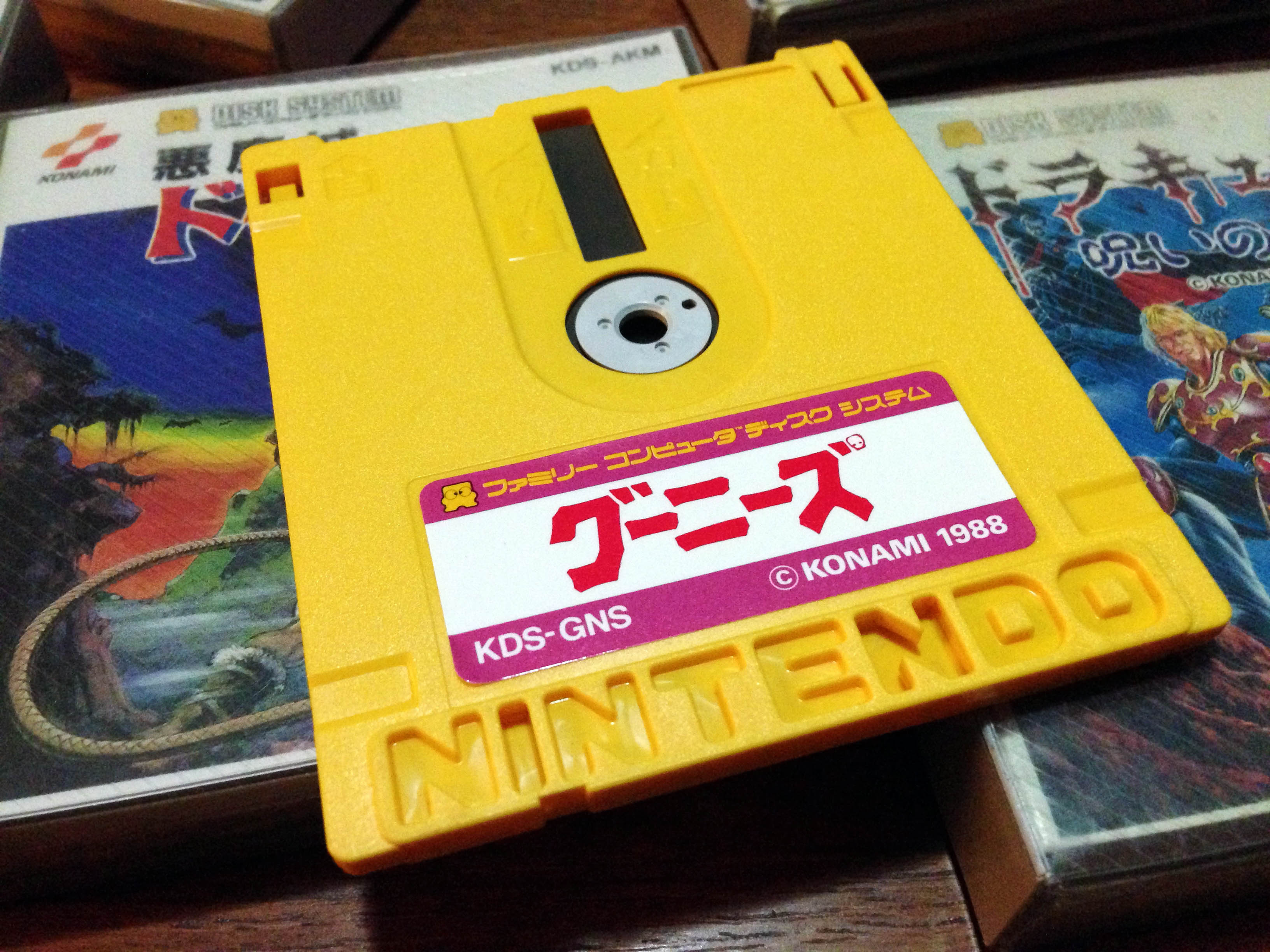

Disk Writer games came with a nice official printed disk label and fold-out paper manual.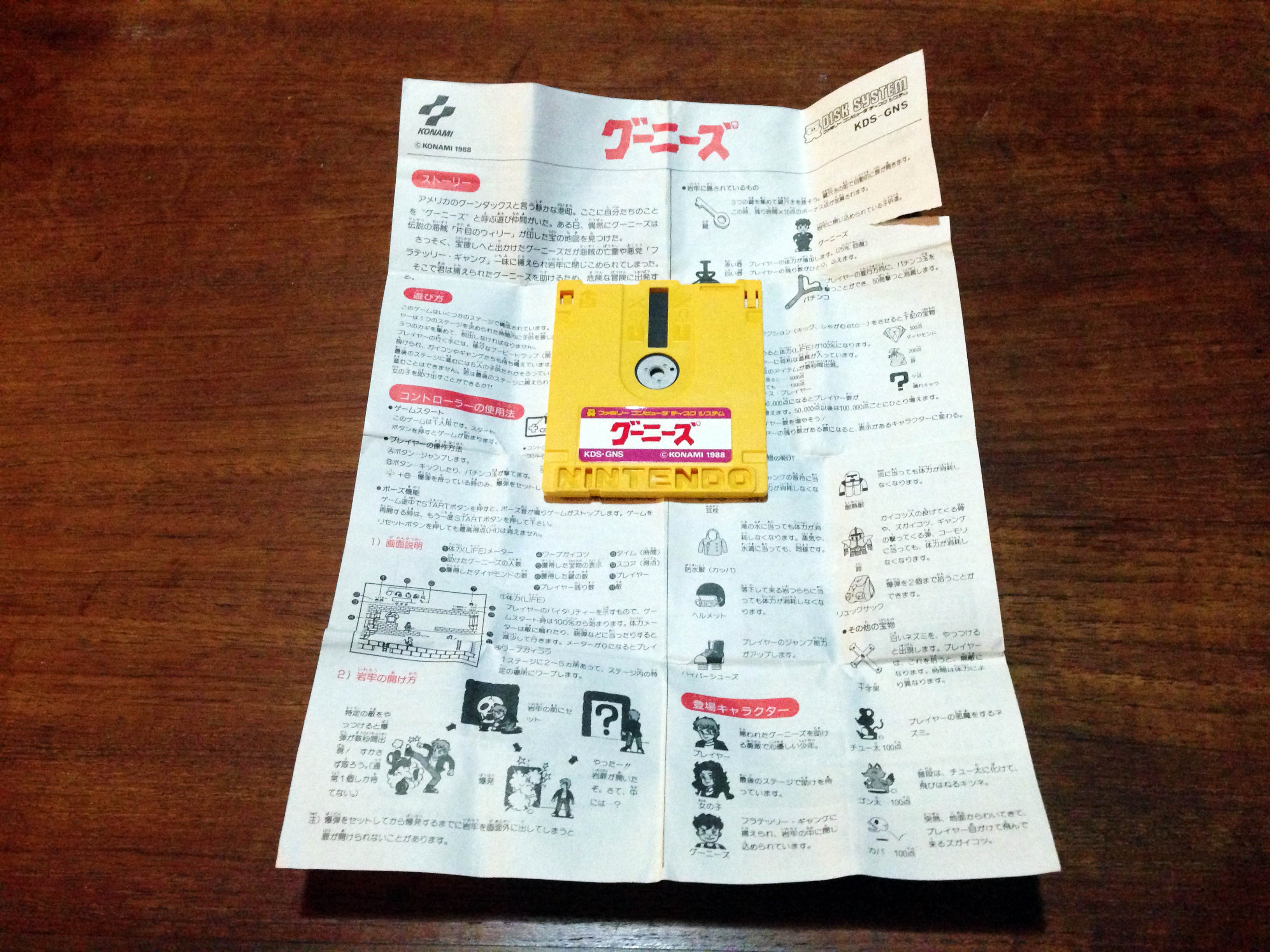
But it doesn’t match the rest of the otherwise beautifully consistent Konami Disk System catalogue.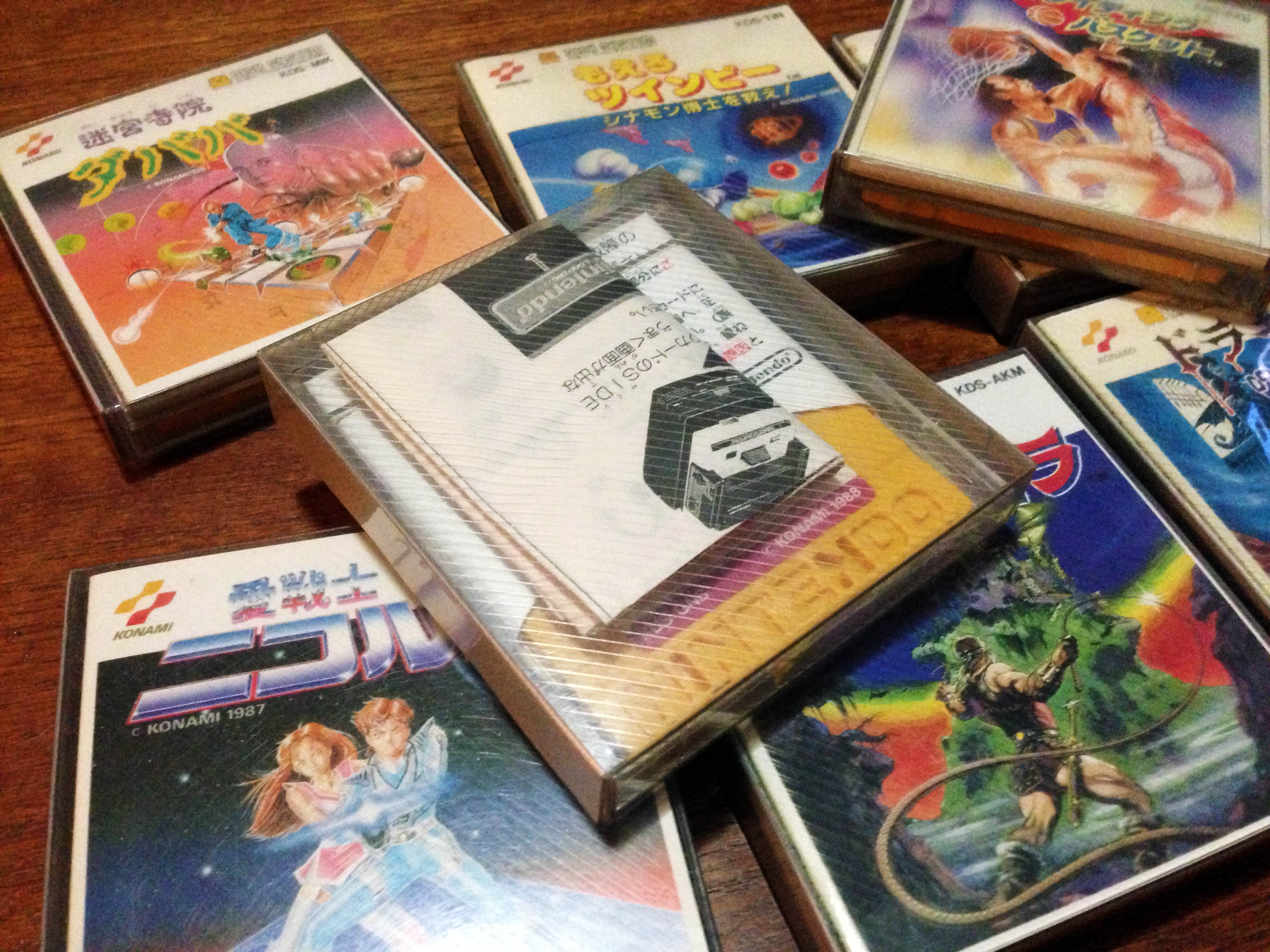
Since FDS inserts are just thin cards, I decided I could make up a reproduction retail release for Goonies, based on the cartridge box.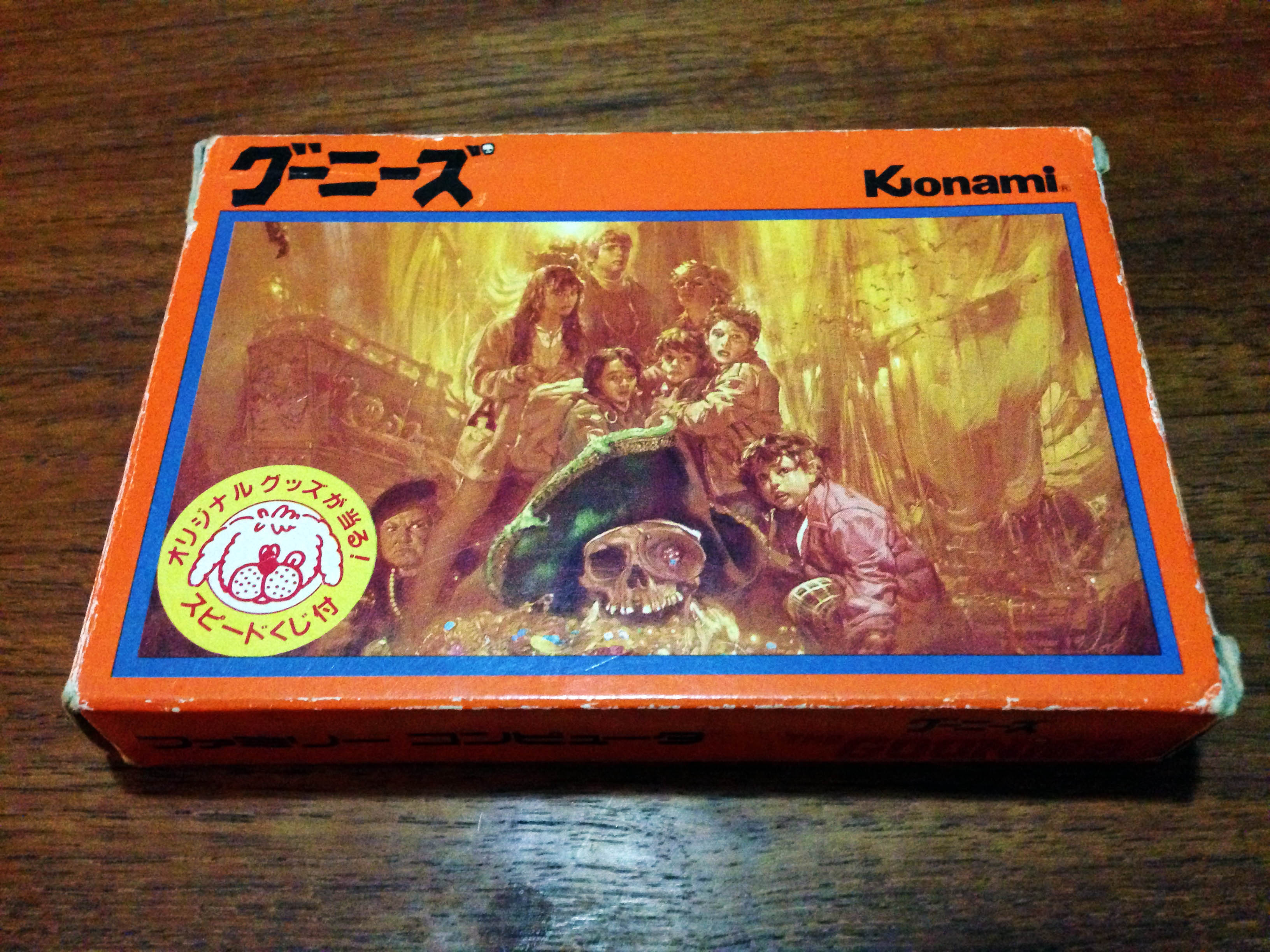
I scanned the nicer quality image from the cart label, and got going in photoshop.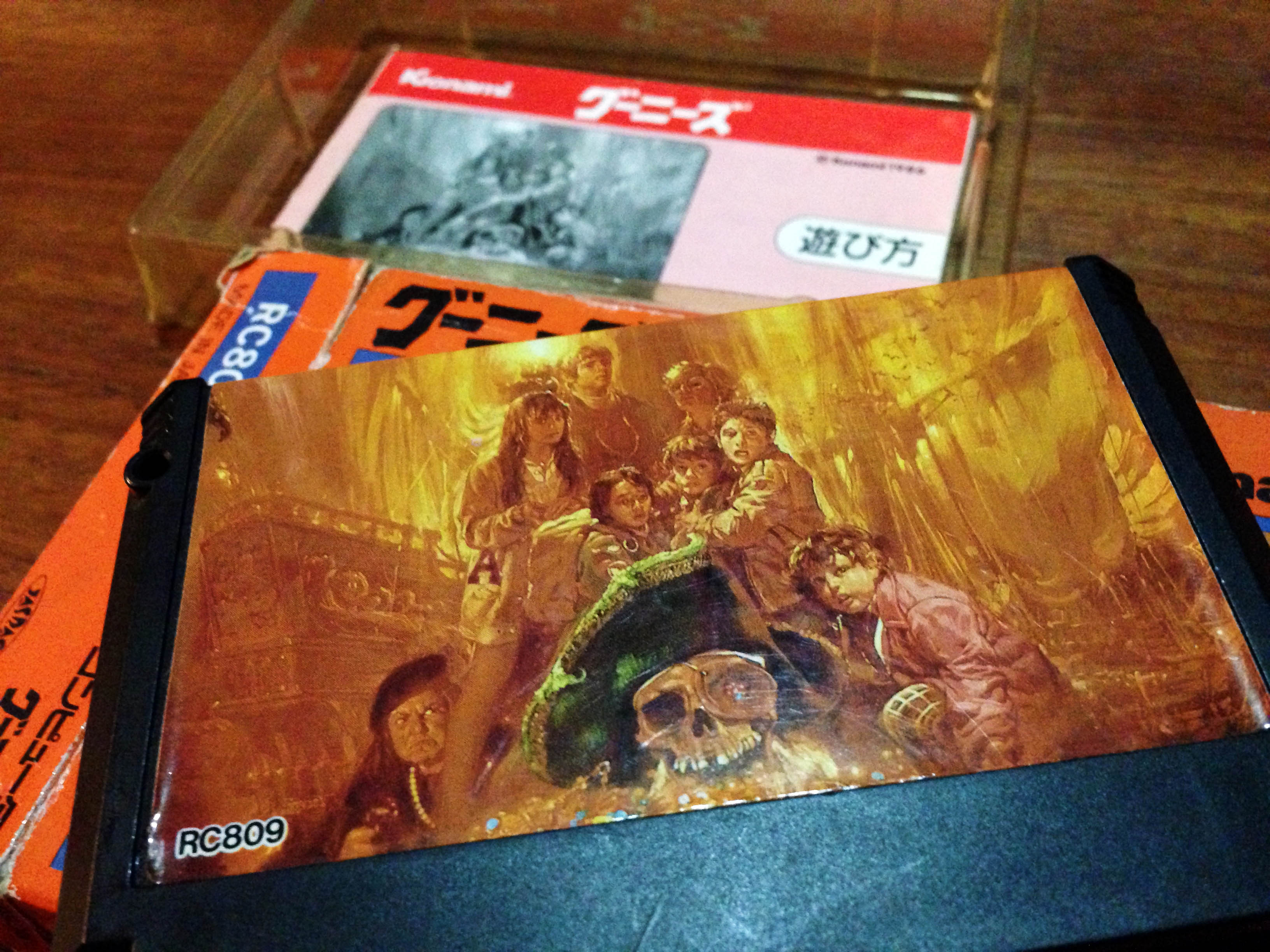
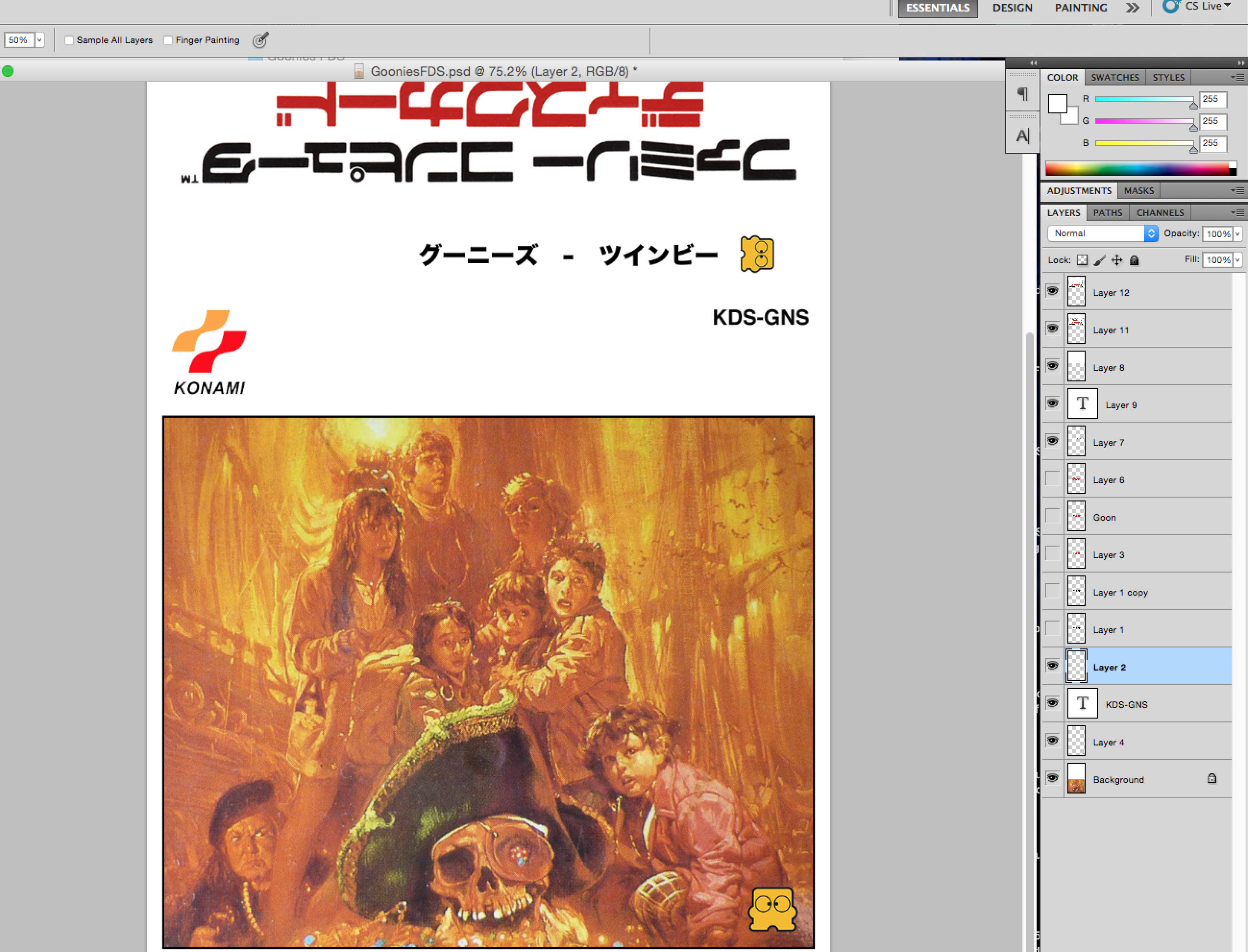
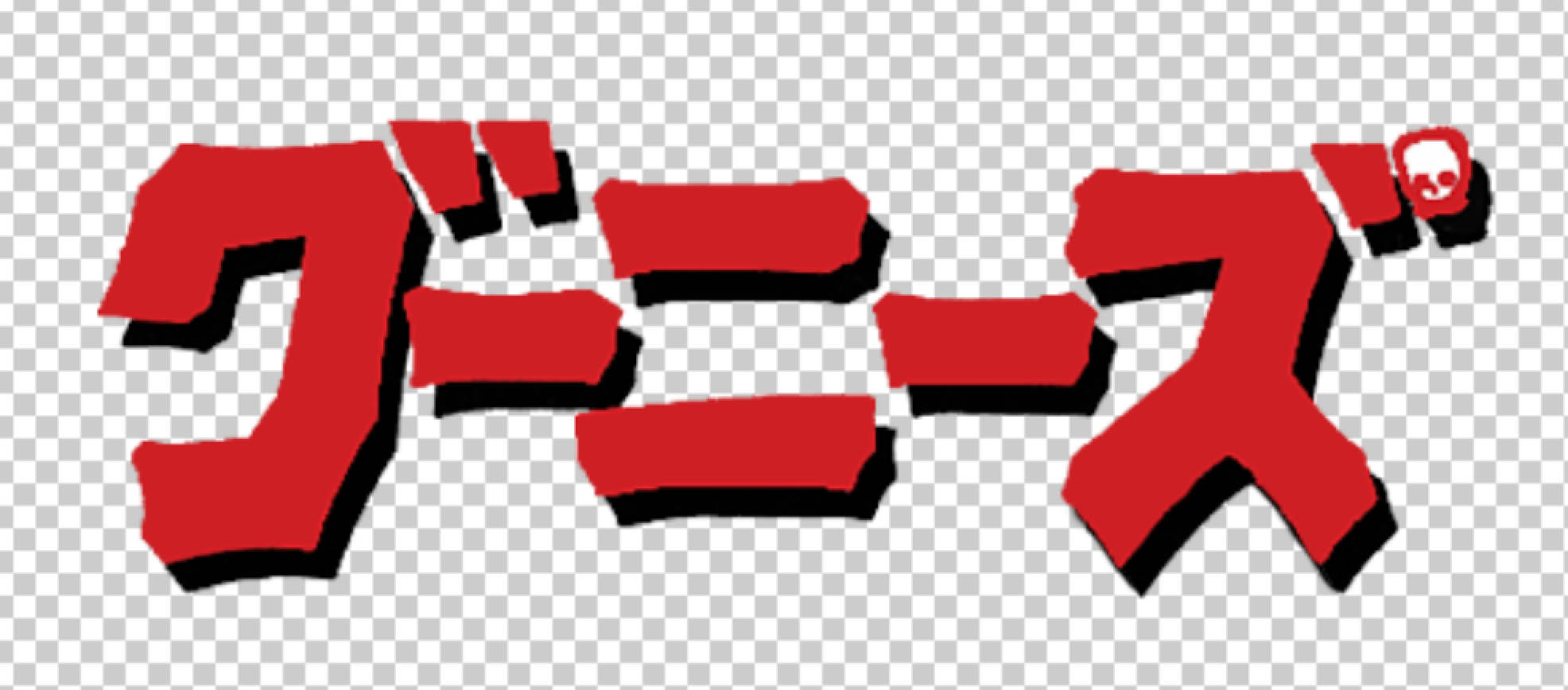
For the logo, black looked a little bland, so I took inspiration from Goonies 2 and Akumajou Dracula, and went with red, using the original black logo from the cart release as a drop-shadow. I used Akumajou Dracula and Exciting Basketball as templates for the basic formatting of the disk case label and outer-box label.

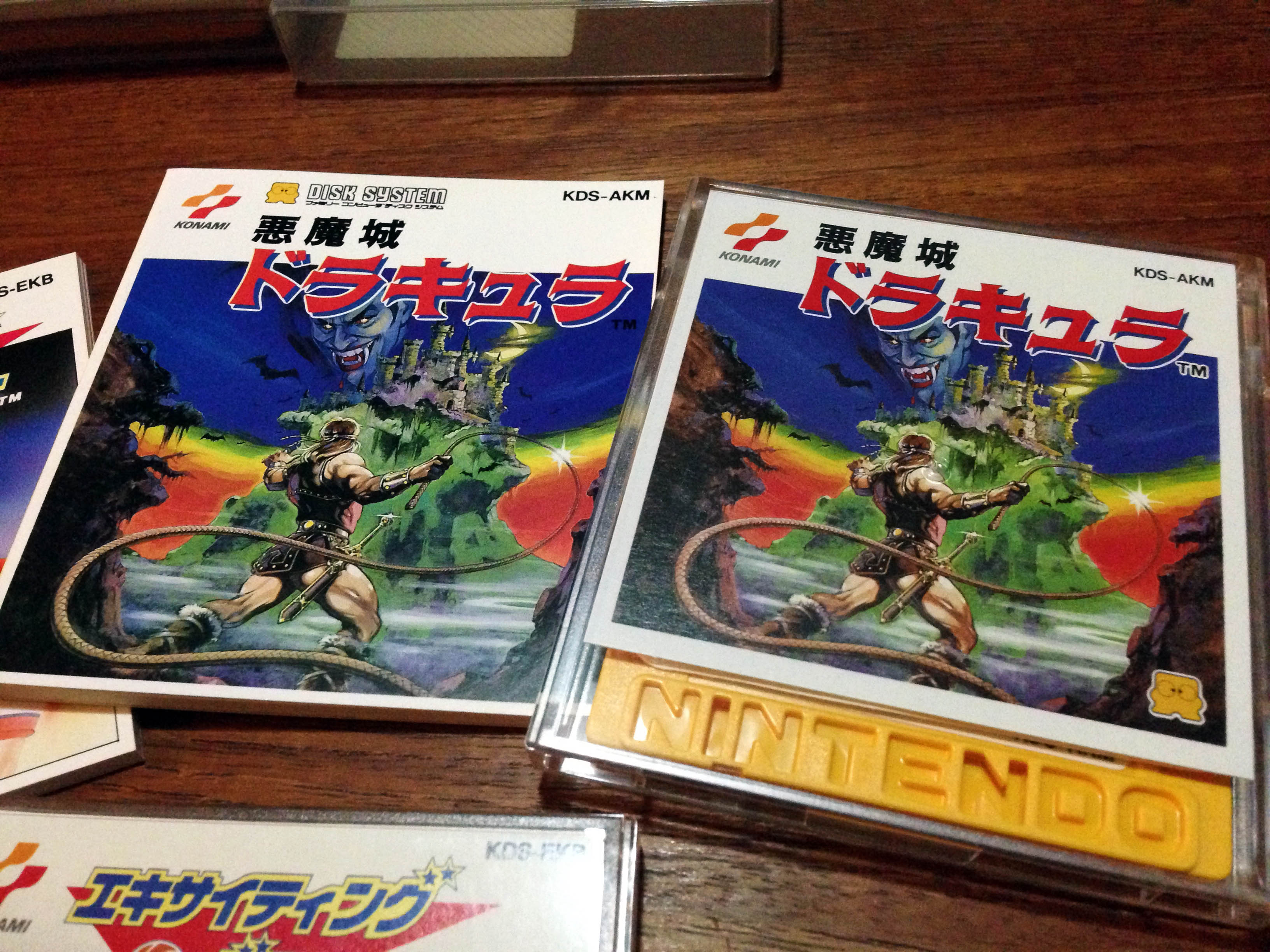
I had it professionally printed on 200gsm satin printing paper, and here’s the result! Goonies on side A, Twinbee on side B, so Goonies gets main billing.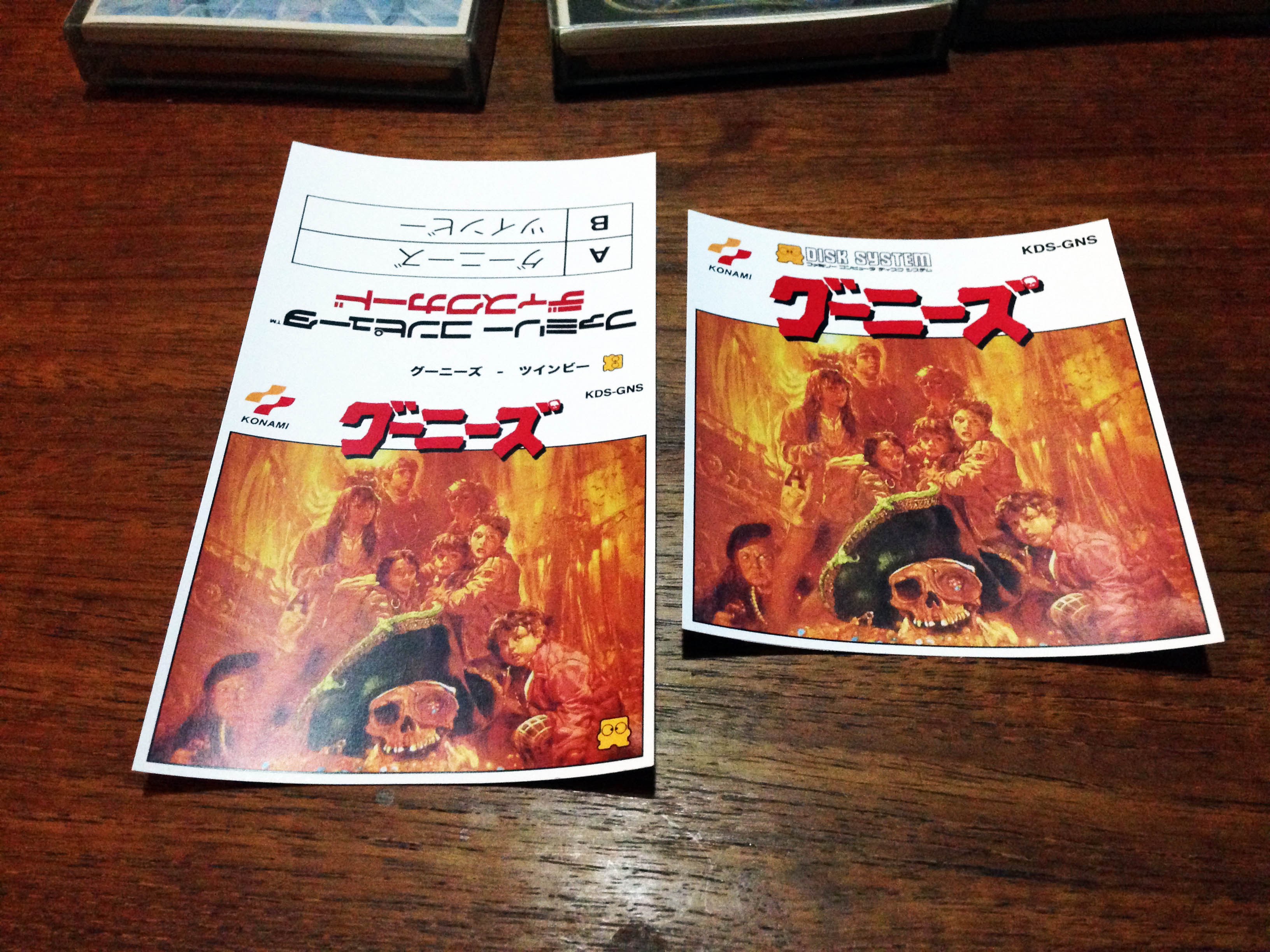
Looks great in disk-case format and full case format!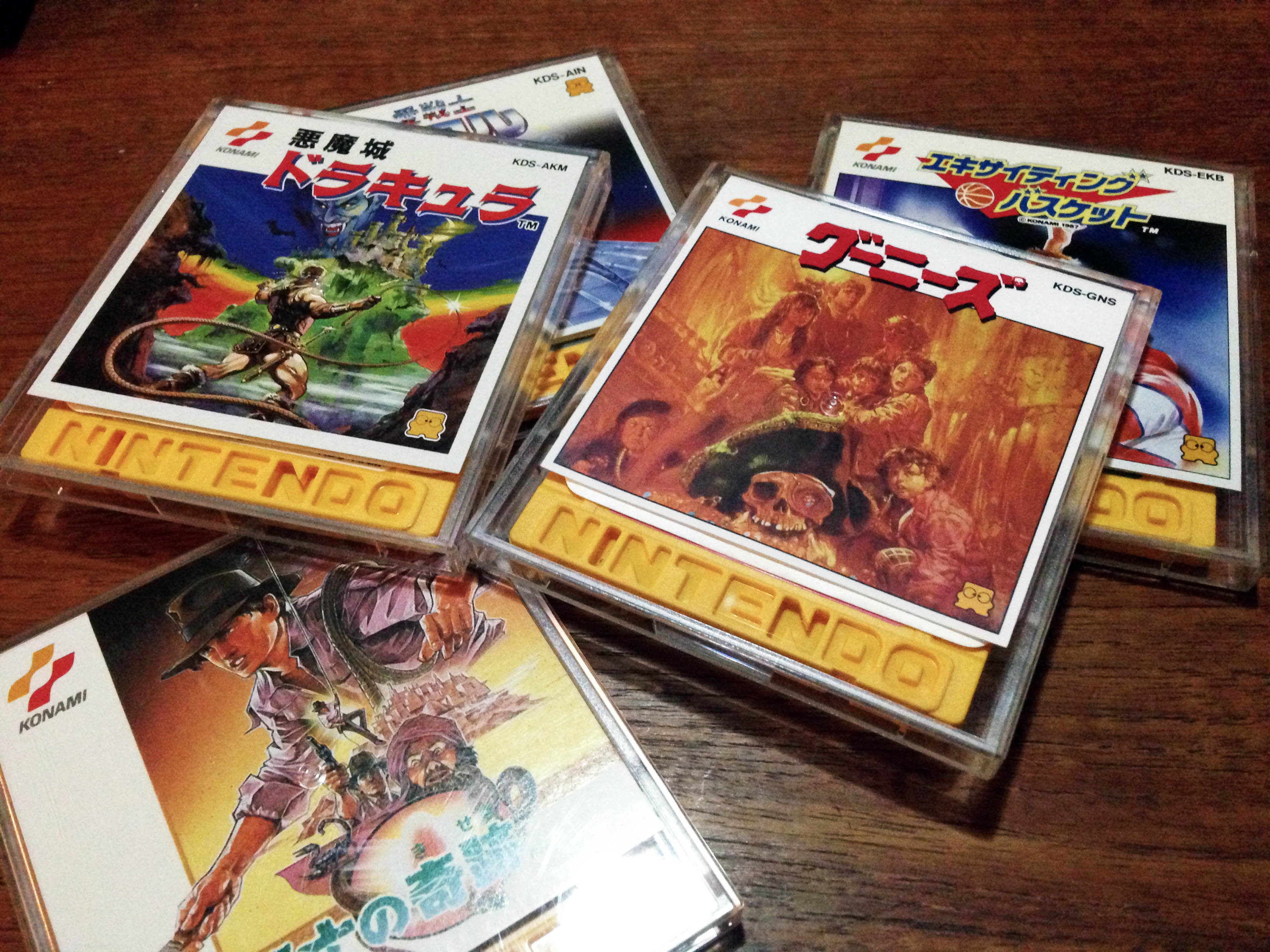
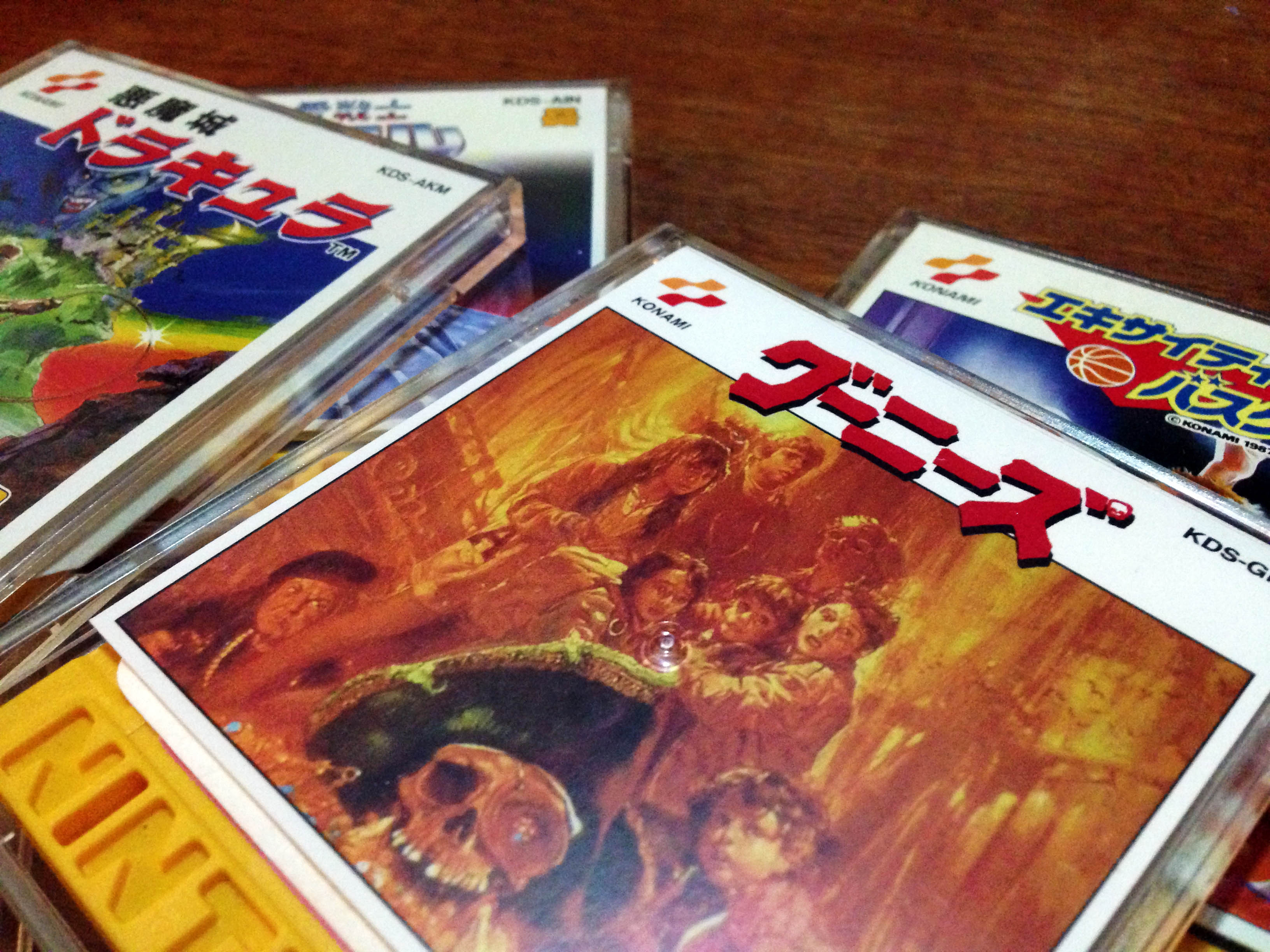

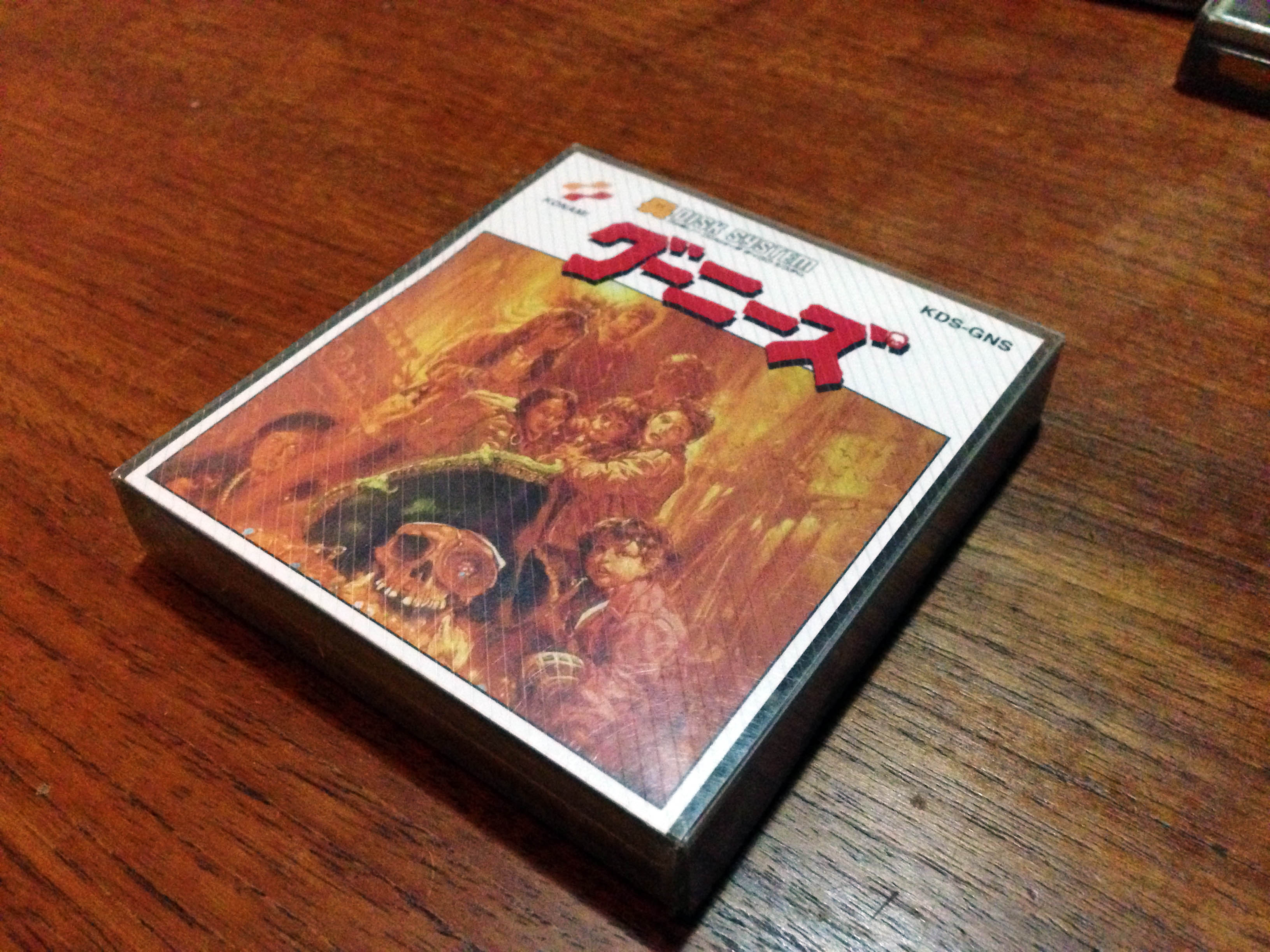
Now Goonies/Twinbee can take its place with the rest of the Konami FDS set!
And I can finally play Goonies with additional load times!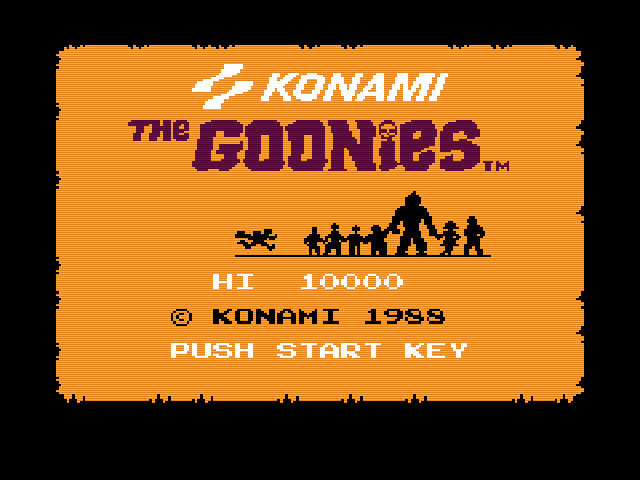
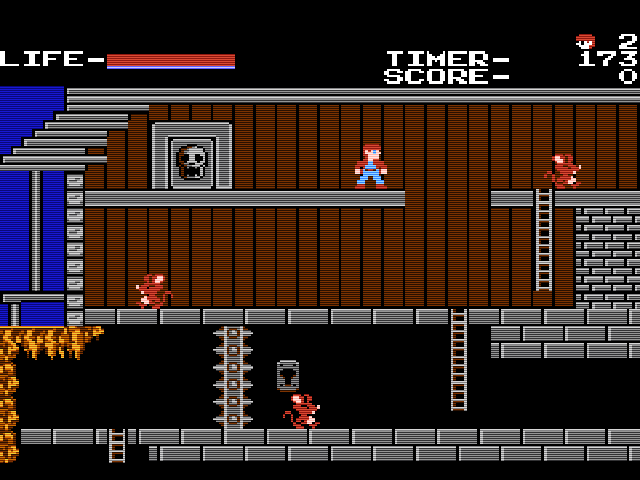
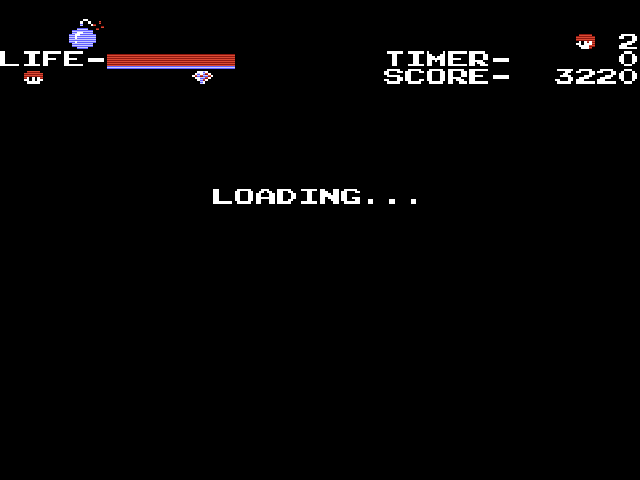
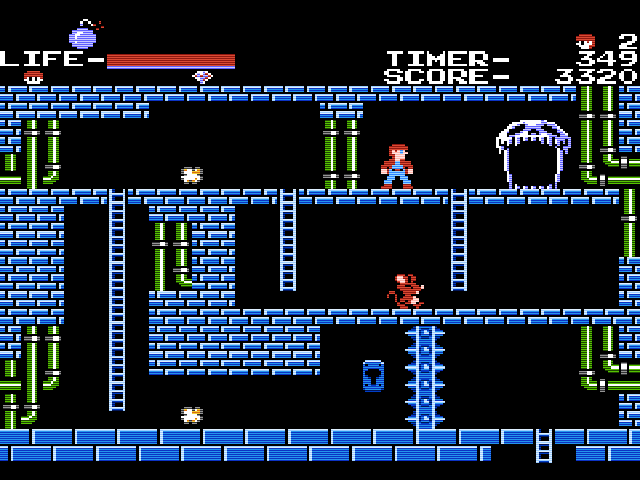
Goonies Family (Computer) photo.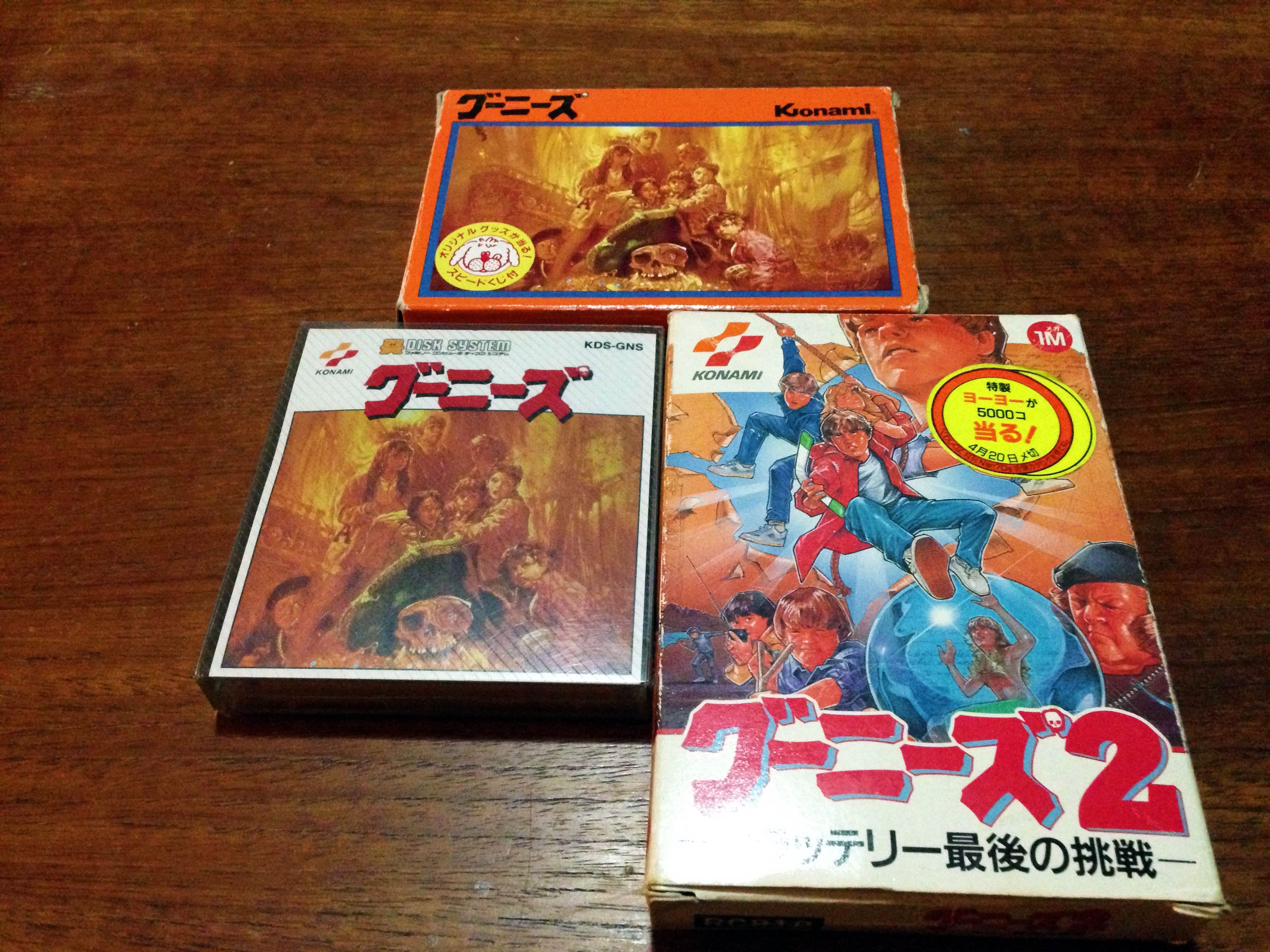
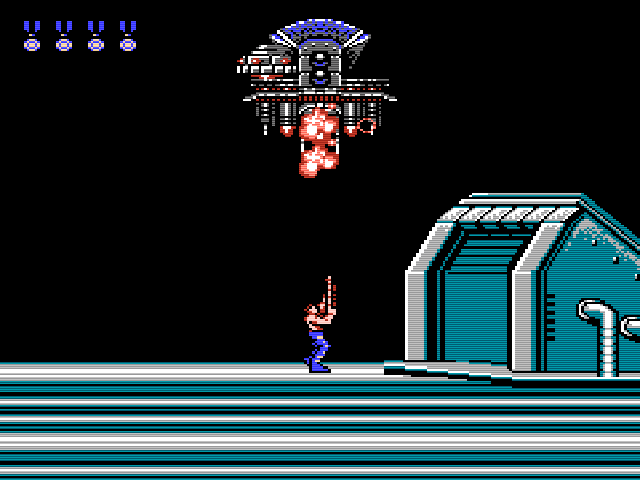
How good is the original Famicom Contra?
 So good even the cut-down American version and robotomised Australian/Euro versions are still awesome.

What is it that makes Contra so great?

The whole idea is off the charts awesome from the start. Rambo and Dutch (Arnold’s character from Predator) vs the Aliens from Alien. Much like how Castlevania was a pastiche of classic monster movies (Dracula, Frankensten, Mummy Man etc) Contra is based on an 80s dream movie we never got.

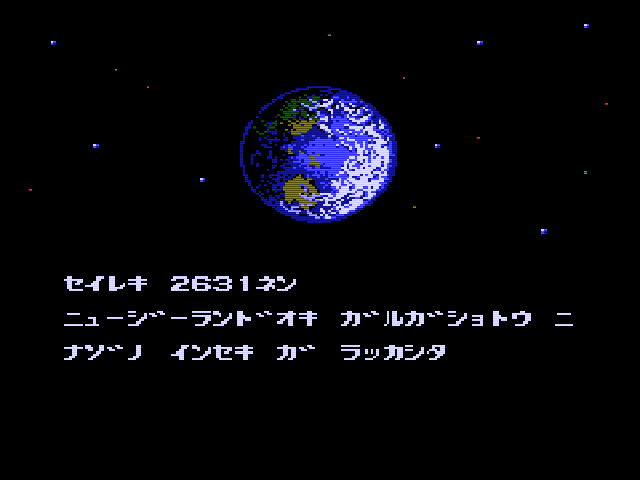
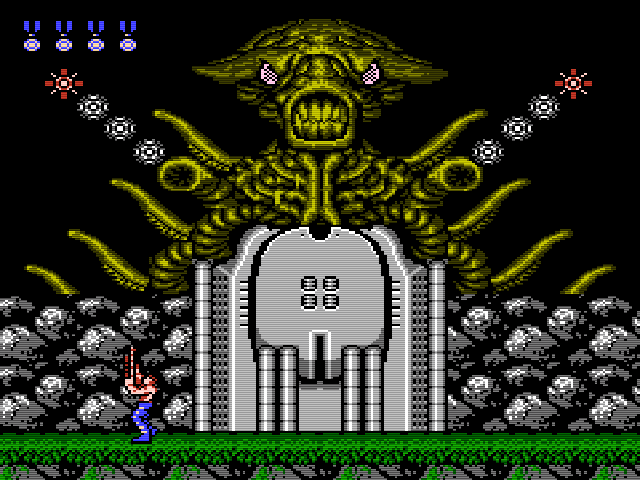
Lush jungles (apparently New Zealand), futuristic enemy bases, a subterranean alien lair – so many classic 80s macho-man settings are covered. And it looks fantastic, particularly the Famicom version (over the NES versions) with more effects, animated trees in the jungle and snow field levels, and animated alien squirming in the final stage. The music is packed with ‘big action movie’ tunes that could have been written by Jerry Goldsmith himself, and the sound effects are suitably chunky and expressive.

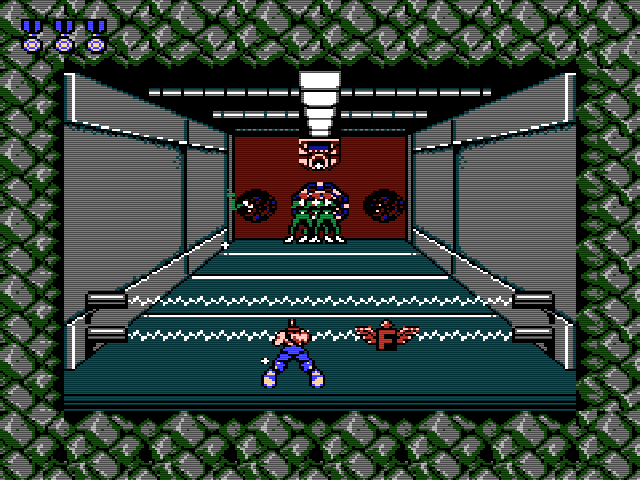

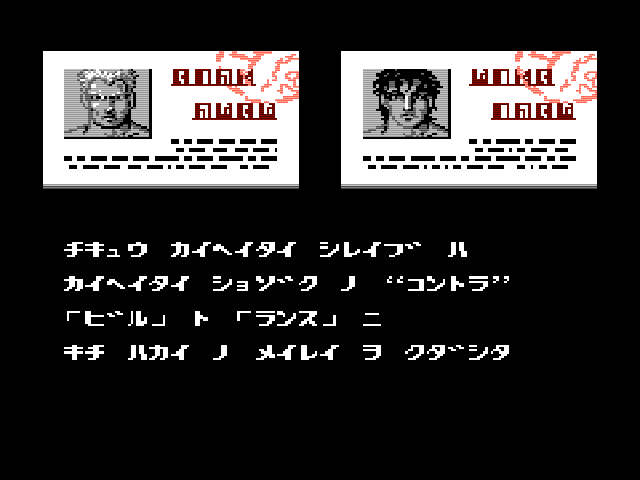
The Fami version also has cut-scenes and a rather cool Ghouls n Ghosts style overworld map.
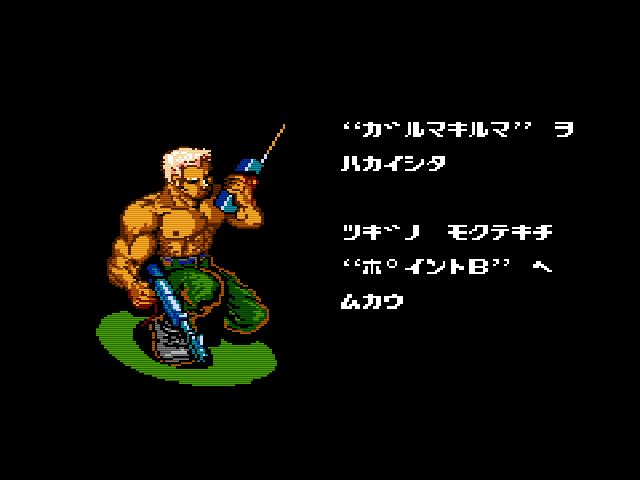

Of course ultimately it’s the killer gameplay that makes it an all time classic. Taking shooter and platfomer and melding them into a cohesive whole for the first time.

It has literally perfect controls. I wish every game on the Famicom had such amazing controls. It’s satisfying just to move and shoot, and you always know a death was your own fault.

Enemy and boss designs are tuned to offer a pitch-perfect challenge. The variety of tasks, settings, and ideas was top of the industry at the time of release.
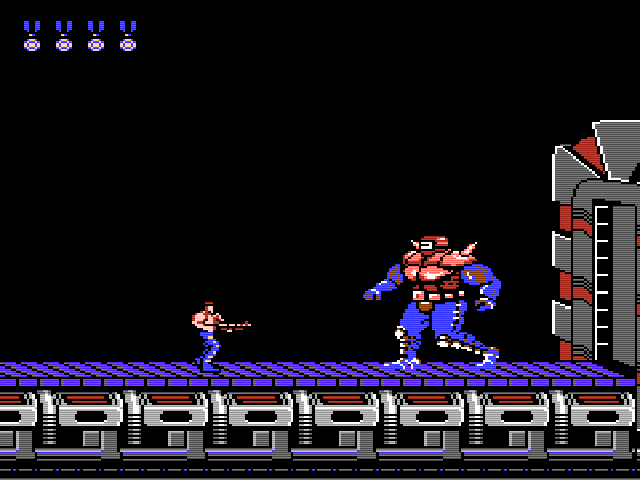
The arcade game was very good, but the team that ported it to the Famicom are the ones who got it most right. The more colourful, tighter controlled home version is one of the rare times that a home port eclipses an arcade original.
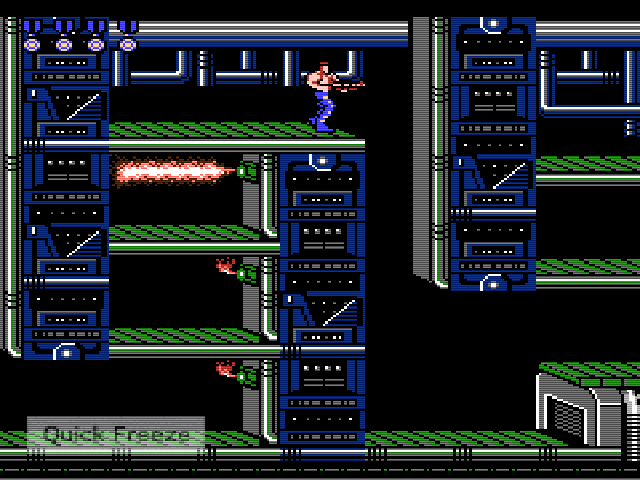


The Contra series unfortunately didn’t last as long as it should have as a top-tier franchise. Two equally excellent sequels (Super Contra and Contra Spirits) and a very good side game (Game Boy Contra, known as Operation C in the U.S.) got the formula right, but after that a series of missteps basically killed the brand.
A pretty bad NES spin-off (Contra Force, which was originally an unrelated project known as Arc Hound) started the trend, and was followed by a Mega Drive spin-off (Contra: Hard Corps) which was good, but in my opinion messed with the formula too much. Fiddly controls, drab settings, bad overly crunchy sound effects, and a techno soundtrack that ruined the 80s action movie feel.
Four terrible-to-mediocre games followed on PS1/PS2, all of which continued to misunderstand what made the first four games great. The first PS2 game (Contra: Shattered Soldier) was the closest to understanding Contra, but still wrecked the formula with mushy controls (likely due to the game’s 2.5D presentation which almost never works well), a stupid cycling weapon system and a lame ’emo teenager’ techno-metal soundtrack and presentation style.
It was’t until the brilliant Contra 4 for Nintendo DS in 2007 that we finally got another game that got the formula correct again, and was truly worthy of the Kontora name.

But here’s to the original Famicom game. It has been equalled, but has never been topped in its genre, even 27 years later.

The Japanese version is one of the games that came with a collector card. I finally got a copy with the card recently of a decent price, so now I’m up to 9/20!








Want that classic Famicom feel without the hassle of having to sit two feet from the console?
Here’s the solution.

It’s an NES controller board and cord in an original Famicom pad shell.

Glorious gold faceplate on rich burgundy plastic. Rounded corners for that premium experience.
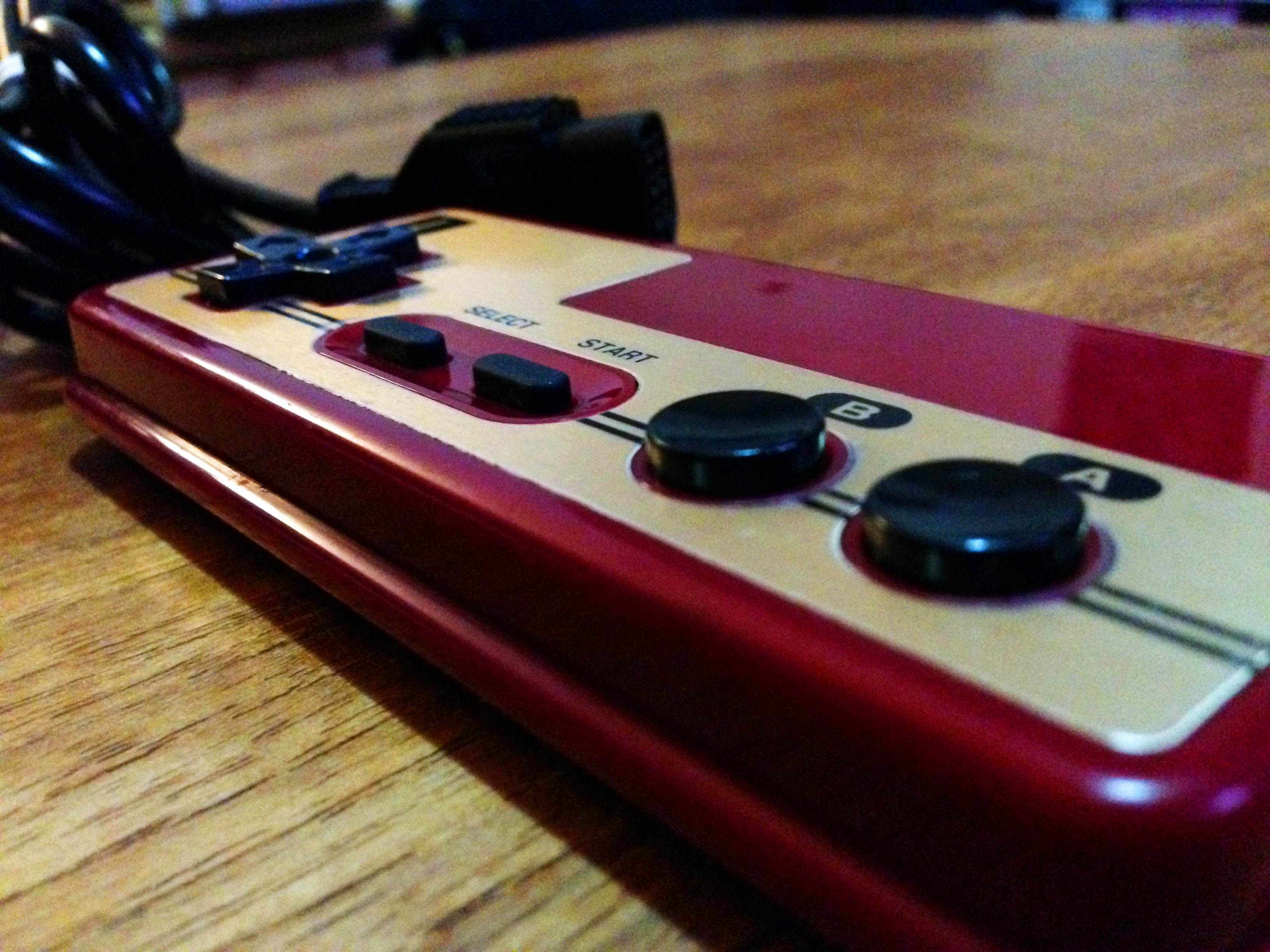
All the class, prestige and comfort of the original classic, without the hassle.

Perfect for the discerning Famicom enthusiast’s AV Fami needs.


I do the same with The Super Fami. None of the SNES’ ugly lavender concave button nonsense, but with a much longer controller cord than the Super Fami pad.

Of course, Super Famicom Jr. controller cords are the full length already. But this sucker is staying mint in the box for now.

My ready-to-go Nintendo controller drawer. Sometimes you want Famicom, sometimes you want dogbone, and sometimes you want to rock out gajin style on the squared off NES pad.


