Similar to Smash Ping Pong, Circus Charlie is a Konami arcade game that was released on the Famicom, but published by another company. In this case the publisher is the mysterious Soft Pro International, who dropped a few 8-bit games in the 80s then disappeared.
In the game you play as Charlie the clown, and must perform various stunts for the crowd over five levels. The first level has Charlie riding a lion and jumping through rings of fire.
There’s also tightrope walking, trapeze, balancing balls, and a strange level where you jump onto trampolines from the back of a pony.
It’s very much in the early 80s arcade mould of simple, short levels which repeat after a loop, and the goal after seeing each level is simply to get the high score (think Donkey Kong).
It’s a relatively faithful adaptation of the arcade game. Five out of six levels are intact, and they play almost identically, despite the move from vertical to horizontal orientation.
But while sound effects and music are pretty much on par, the graphics have taken a pretty big hit. Gone are the bright, colourful tones of the arcade, replaced with a sad, drab circus right out of the Communist Bloc.
Comrade Charlie?
Matching the early Famicom arcade heritage gameplay and presentation, Circus Charlie comes in the original small size Famicom box, much like the first Nintendo games, and the original Konami orange package line.
Circus Charlie was later released in original arcade form in the compilation packages Konami 80’s Arcade Gallery on the original Playstation and Konami Arcade Collection on Nintendo DS. The Playstation version is pretty much the go-to if you want to experience Circus Charlie properly. The DS version is a nice novelty but to view the game in correct vertical resolution you need to hold the DS sideways which is pretty awkward.
As for the Famicom release? It’s still pretty fun, in that pre-Super Mario Bros arcade gameplay kind of way. It is however extremely rare. I bought the only boxed copy I have ever seen.
Sega were king of the arcade for most of the coin-op format’s history, and their console efforts often attempted to leverage their arcade success into home success. While this would eventually lead them to release one of their arcade boards as a console (the Mega Drive is basically a cut-down Sega-16 board), on their first two consoles it meant ports.
And so we have the Mark III release of Shinobi.
It’s a late enough Mark III release to have the Master System co-branding.
Shinobi is a basic 2D side scrolling action game, which was already a fairly recognisable format by 1987. It stars Joe Musashi, on a mission to stop bad guys who are kidnapping children from his ninja clan.
You move along the stage, attacking bad guys with swords and ninja stars while freeing the kidnapped kids. The game’s gimmick is multiple ‘planes’ of action, and at certain points in stages you can switch between planes with a giant ninja jump. Luckily the bad guys are nice enough to pause and wait for your jump to complete (it’s really supposed to be a sort of ninja movie slow-motion effect I think). Otherwise controls are decent, solid but standard.
It’s broken into five missions of three or four stages each, with a boss at the end of each mission. Along the way you can power up your life bar and weapons, swapping out ninja stars for bombs and a knife, and your sword for nunchucks and eventually what appears to be a Castlevania-style chain whip.
Some later stages can get quite frustrating, introducing bottomless pits and annoying enemy placements. Enemies get weirder and more supernatural as you progress, including some zombie-ninjas and demons.
Bosses are quite good, and largely rely on you working out attack patterns and counter-attacking. With one exception – a giant wall of hindu (Vishnu?) statues. After a million attempts I finally worked out the only solution was to spam it with knives, which worked. Frustrating.
There’s also a very difficult bonus stage once a mission, where you throw ninja stars at two planes of ninjas, shooting gallery style.
Graphically it’s decent, but nothing special. Pretty middle of the road for the Mark III. Some incredibly strange palette choices make some parts, especially the first stage, look quite garish, but other stages are fine.
What is up with these colours?
The Mark III version is a reasonable interpretation of the arcade game. The arcade game is a much faster, more fluid experience, whearas the home version is a slower and more methodical. There are less enemies, but despite the very different feel, the levels have been recreated quite faithfully.
The graphics have also taken a hit from the 16-bit arcade game, but the bright Mark III colours arguably make it more appealing in parts than the drab original.
One disappointing element is a common one for Mark III games – small cartridge size. The Mark III had some design flaws that meant it got less graphical tiles from the same amount of ROM than most consoles, and on top of that Sega often chose cheap small cart sizes. What this means is only a couple of tunes for the whole game (much like Makai Retsuden). And what happens when you beat the final boss, the Masked Ninja?
You get this amazing ending:
Wow, what a reward.
The tunes at least have FM instrument support, and sound pretty cool if you have an FM Unit.
Overall it’s a pretty nice early ninja game, and pretty fun, even if incredibly difficult at points.
Konami’s first Famicom line was basically a direct copy of the Nintendo template, except with consistent orange colouring. There were seven games in the series, and this is the complete set Road Fighter, Antarctic Adventue, Hyper Sports, Twinbee, Hyper Olympic, Yie Air Kung Fu, and Goonies.Goonies was somewhat of a transition game – it skips the uniform ‘FAMILY COMPUTER’ branded sides of the preceding six releases and started the short-lived ‘puppy face’ icon period. The next Konami release was Gradius, which is I believe the final Konami release to feature the old 70s style logo.The next evolution is shown here in King Kong 2 – which maintained the size of Gradius and introduced the new Konami logo.Contra is an early example of the final evolution, with the artwork framed by a bright colour which covered the rest of the box, and the Konami logo on a white background in the top left corner. Almost every Konami game for the rest of the Famicom generation followed this final template.
Managed to get myself one of the most awesome Game & Watch releases – Donkey Kong Jr. Panorama Screen version!
Originally released as a mini-arcade cab like ‘Tabletop’ Game & Watch, Nintendo re-tooled the basic tech of the Tabletop idea into a portable that folds flat to about the size of a Multi-Screen Game & Watch.
The top part is the LCD and a ‘light window’ which allows an external light source (like a lamp or sunlight) to shine through, displaying colour graphics. the image is then reflected on a mirror on the other half of the fold.
And the results are amazing!
It’s quite an involved piece of tech, and this version of Donkey Kong Jr. is easily the closest thing you could get to playing the arcade at home in 1982. There’s much more involved than the Widescreen Donkey Kong Jr. It even has a musical intro and interludes!
Here’s a screen of all the graphics lit up, so you can get an idea of how it plays.It’s easily one of the best Game & Watch releases. Great little game, and it would have blown my mind back in the early 80s.
This is a follow up to a previous post on the Konami collector cards.
Recap: At some point starting in 1987, Konami decided to include a collector card with all their Famicom titles. Each card had an illustration related to the game; some cards featured screenshots or pieces of screenshots, others had artwork of scenes in the game.
After much searching, I have now almost completed the set! While there were multiple cards per title in some cases, I’ve only collected one per game.
It seems unlikely I’ll ever get a complete copy of Exciting Boxing. It came in a huge box with a novelty inflatable controller, and commands insane prices online now.
Alex Kidd – Sega’s most direct answer to the popularity of Mario
Much has been written about Sega’s history of creating ‘answers’ to Nintendo’s ideas. The reality is almost everyone in the space has copied Nintendo to some extent and in some capacity, it’s just that Sega was the closest similar competitor for longer than anyone else, so the examples pile up higher.
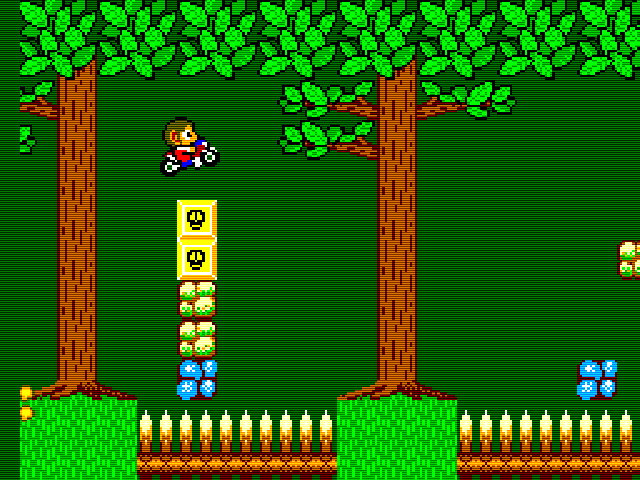
Which brings us to Alex Kidd in Miracle World, released a year into the life of the Mark III, and in the wake of Super Mario Bros. explosive popularity. Miracle World is such a straightforward answer to Super Mario Bros. nobody ever tried to deny it.
One of these things is a lot like the other…
Starring a red-jumpsuited monkey boy clearly designed to evoke ‘young Mario’
It’s quite typical of the platfomers released on Super Mario’s wake.
It has the destroyable blocks with money and power ups in them, plus land based platforming and swimming levels. Its efforts to differentiate itself from Mario include vertically scrolling levels and stores in which to buy power-ups.
It also has its own combat method (punching), and jump and attack are reversed from Mario’s rapidly-growing standard layout. You get used to it, and it can actually be advantageous depending on how you hold the pad, but it’s jarring to start with. In a later western release of the game, the buttons are reversed to the Mario standard in a full admission of defeat.
Jumps are a bit floaty, and movement a bit mushy overall, but the controls are decent. Moving carefully you can make your way through the game fairly easily, punching away at enemies with relative success.
It seems likely the game was developed by the same team as Ghost House, since the controls and graphics, and even main character, are quite similar.
What Alex Kidd has going for it are a variety of environments and gameplay styles. As mentioned, just like Mario there are swimming levels, but Alex has a few vehicles available as well. The motorcycle is an optional power-up, purchasable using the in-game cash at stores in some levels. It works somewhat like the skateboard in Wonder Boy, in that you career headfirst at a super fast pace until you hit a hard object and the bike evaporates. There’s also the Ballon Fight like helicopter levels and a water based motorcycle equivalent in the speedboat.
While the game is otherwise mostly a standard meandering platformer with fairly mediocre level design, some later levels resemble action puzzlers, such as Utopia’s Montezuma’s Revenge, or Konami’s Goonies, except much more basic. Overall it’s fairly boring from a gameplay perspective, even with the gimmicks.
Boss battles are the worst feature of the game. Instead of any kind of action, in most cases the battles are largely decided by a paper scissors rock game. It’s like you leave action-game land and enter a casino where your opponent can view your moves. Following the ‘Janken’ match, most bosses then attack physically in a limited fashion, usually by throwing their disembodied head around the screen in a random pattern.
It’s a pretty good game graphically for 1986. Nicely dawn characters with lots of detail, and colourful worlds to explore.
The music isn’t that great. While the tunes are catchy, they’re no Mario theme, and like SMB there are only a few pieces that repeat throughout the adventure. The Mark III has worse sound hardware than the Famicom, and unfortunately there’s no FM soundtrack.
Alex Kidd’s first adventure also unfortunately remains his best. A bunch of what were essentially spin-offs followed, none of which were much good. The only actual sequel was a 1988 Mega Drive launch game, known as The Enchanted Castle in the west, and while it’s easily the second best ‘Kidd, it’s pretty janky.
Alex Kidd in Miracle World didn’t set the world on fire in Japan, but is a fondly remembered game in many PAL territories due to it being built-in game of the majority of Master System consoles released. But while the original game isn’t exactly a classic, it’s surprising Sega never did a revival.
This is the full set of Konami Famicom Disk System games.Up front you can see the two games I covered recently – Smash Ping Pong (which was published by Nintendo), and my custom designed Goonies/Twinbee ‘retail’ box, housing the official Disk Writer releases of those two games. There’s also the DoReMikko box up the back, and disk at the front.
Some true classics here. There’s the obvious brilliance of Arumana no Kiseki, Akumajou Dracula, and Ai Senshai Nicol, and the awesome shooters Falsion and Gyruss.The sports games are top notch as well, I love Exciting Soccer and Konami Ice Hockey in particular, while Exciting Basketball has fantastic music missing from the NES version. Exciting Baseball and Exciting Billiards are great too.
Really every game has its merits, from the cutesy platformer Bio Miracle Bokette Upa, the creative spin on the Breakout formula in Nazo no Kabe: Block-kuzushi, the alternative layout of NES Jeep shooter Jackal in Final Command, to the flawed but revolutionary Dracula II.Konami. In the 80s and early 90s they were Nintendo’s equal.
DoReMikko (ドレミッコ) is a game I never thought I would ever be able to obtain. It usually goes for hundreds of dollars. But a few months ago on I unexpectedly won an auction on Yahoo Japan for a complete copy, far below usual price!
The name DoReMikko is a play on ‘Do Re Mi’ – the anglicised versions of the first three notes of the Solfège scale (probably most well known from the song in the musical The Sound Of Music).
It’s a music game/software package for the Famicom Disk System that came with a keyboard controller. The keyboard is pretty nice quality, if a bit small.
There are three main modes.
First up is Concert Mode. Here you can play along with a Gradius melody medley with a full band accompaniment.
You can select the instrument the keyboard sounds like, and set tempo and style, everything from rock to country to techno (and a strangely 4/4 waltz). More options are available in a menu, allowing you to adjust various parameters of yours and your accompaniment’s instruments. You can also record your performances to disk.
If you’re into 8-bit music, it’s pretty fun to fiddle around with the instrumentation, limited as it is.
The instrument you pick affects the animation that plays. Including a full Chuck Berry/Back To The Future style stage rock-out if guitar is selected.
Next up, Solo Mode is a simple keyboard-only mode. You can only select Piano or Organ, and play without accompaniment.
So what’s the point? Well, this mode gives the entire system’s audio capabilities to the keyboard. Effectively it allows you to use your Famicom (with extra Disk System audio channels) as a digital keyboard, allowing up to 10 notes to be played at once in full synth quality. It also features the recording functionality of concert mode. It’s fairly limited, but would have been impressive in 1987 for the price, quite a decent way to record your compositions.
Finally, there’s ‘Play Along’ mode. Each of the boxes contains the accompaniment to a song, and these songs have their music written out in the game’s manual. The keys light up on the keyboard on screen, helping you learn to play the piece. Of course the highlight is once again the Gradius medley.
Overall there isn’t too much to it. It’s actually more useful as a tool to write music on than as a game for entertainment. It’s so trivial today to make quick digital recordings, but in 1987, on the cheap Family Computer, it must have been some budding musicians’ dream come true.
There’s one Konami game on Famicom Disk you probably didn’t know about – Smash Ping Pong (スマッシュピンポン).
Originally released as ‘Konami’s Ping Pong’ in the arcades, Nintendo published the Famicom Disk System version as part of the Famicom Disk launch library. As such, the FDS version is not part of the Konami catalogue, though it is Konami branded on the disk and title screen, and it maintains the official Konami artwork from the arcade and MSX releases.
It’s a pretty nifty and quite realistic take on Table Tennis. The simple graphics bely a quite sophisticated and challenging control scheme and physics system.
Unlike most tennis-based games, you don’t hit the ball with A or B and move around with the d-pad. B throws the ball up for service, and A changes between forehand and backhand. Your disembodied hand moves around automatically to meet the ball. All hits are done with the d-pad left, right and up, and the timing controls the angle and power.
It reminds me a lot of Wii Sports Tennis, released 20 years later.
It’s a very faithful translation of the arcade game, the biggest change being he swapping out of Konami’s Pentaru (from Antarctic Adventure and Parodius) for Donkey Kong in the crowd! Disk-kun (the FDS mascot) also appears in the title screen in his first ever digital appearance.

 In the game you play as Charlie the clown, and must perform various stunts for the crowd over five levels. The first level has Charlie riding a lion and jumping through rings of fire.


 It’s a relatively faithful adaptation of the arcade game. Five out of six levels are intact, and they play almost identically, despite the move from vertical to horizontal orientation.




 Nintendo Sega Japan!

