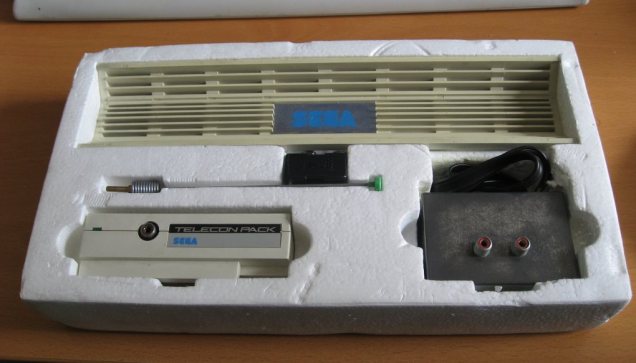
The Telecon Pack is a radio frequency broadcaster for the Mark III.
Sega really went nuts with the accessories in the 80s, but this one makes a lot of sense from a Japanese perspective. In Japan, consoles were designed to sit near the player, and run a long cord to the television. This is the reason Japanese controller cords are so short, and why the SG1000, Mark III and Master System have the pause button on the console – because it was assumed you’d have the console next to you on when playing.
The Telecon Pack would allow you to have the console on a side table at the back of the room with power cord tucked away, and avoid needing a wire to the television for the video and audio.
It connects via the AV port, and then broadcasts the composite signal via a Japanese TV channel.
It originally came with a satellite dish you could plug into your TV for reception, which I don’t have right now.
Picture courtesy of Sega Retro
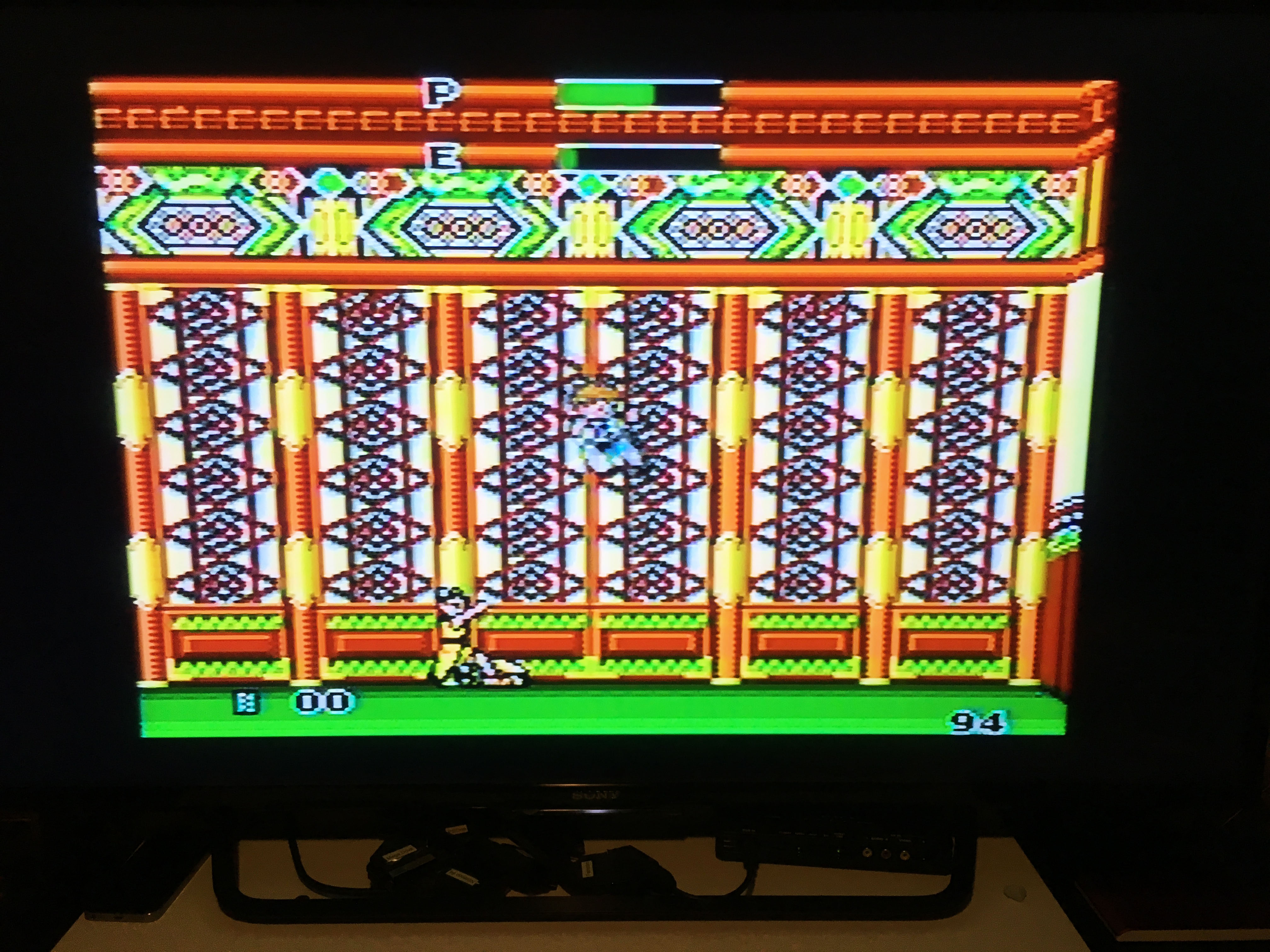
But it actually works fine with a regular television antenna – as long as the TV can tune in Japanese stations. My current TV can, and the results are surprisingly decent. Powering up one of my favourites Makai Retsuden:
It also works fine with the FM adapter, which has the composite signal passed through the adapter cord.
It looks super neat this way.
FM adapter plus Telecon pack on Mark III is the original Sega Voltron console.
Grand Master Sega Voltron Challenge – Telecon Pack to Game Gear TV Tuner
So now we have a Sega console that broadcasts, and a Sega console that can accept broadcasts. Time for the ultimate combo!
The only Japanese TV tuner I have is from the white Game Gear, but unfortunately the white Game Gear needs repair, so I cannot make an all white Sega Voltron.
So I’ll sub in a working recapped Game Gear. I touched the TV tuner’s aerial to the Telecon pack’s aerial for maximum reception.
And there we have it.
Is it the least convenient way possible to officially play Mark III games? Almost certainly.
But personally I think it’s best suited to playing Outrun – with FM audio – on the Mark III!
Mark III set up and ready to rock.
To be honest it’s slightly annoying to use, because Outrun requires you to hold one of the buttons to accelerate. But it oozes 80s charm, and this was the premium ‘Sega at home’ experience of the mid 80s.
You’ve likely heard the story of R.O.B. ‘The Robotic Operational Buddy’ for the NES. The story usually goes like this: when Nintendo wanted to bring their successful Family Computer console to America in 1985, the stores wouldn’t take it because they were afraid of losing money on video games, as there had just been a big video game market crash. So in order to get toy stores to stock the console, Nintendo initially bundled the NES with a toy robot and marketed it as an electronic toy instead.
Some of the story might be true, but R.O.B. was actually released in Japan first, as the Family Computer Robot.
Nintendo was a toy company before they were a games company, and there were many existing examples of the company combining electronics and toys before this. Among the most notable are the original electro-mechanical light gun games: at home (Electro Safari and Electro Bird) and in the arcade (the original versions of Wild Gunman and Duck Hunt).
So really, the robot and its accessories were just part of a long toy/game continuum that continued throughout the Famicom era with peripherals like the Power Pad and all the way through to today with Amiibo and Labo.
The games that were compatible each came with a veritable toybox of additional parts, and are essentially complex mechanical games that use the robot as a central item. Only two games were released, Robot Block and the more elaborate Robot Gyro.
The Family Computer Robot uses pretty much identical technology to the light guns of the day, but in reverse, so instead of the screen responding to the peripheral, the peripheral responds to the screen. Like light guns it relies on the screen scanning display technique of a cathode ray tube, and so will not work on modern fixed pixel screens, even via a scaler.
Sorry Framemeister, you’re not up to this task.
So for robot games, a CRT is required, luckily I keep one on hand for just such an occasion.
Essentially the robot needs to be positioned so he can see the screen clearly in order to respond to the commands he is sent.
The robot can receive commands from the screen and execute a simple movements based on them. He can move his arms up and down, left to right, and can open and close his grip. This movement set allows him to pick up and move objects.
The two games approach the concept of ‘robot which can pick up items’ differently. Robot Block primarily makes the physical element of the game the primary one, integrating the Famicom software into the mechanical game. Robot Gyro is essentially a regular video game which includes the robot (and gyro) functionality as a physical gimmick.
Robot Block (ロボット ブロック)
Robot Block is the simplest of the two games, in both set-up and software. It comes with a series of attachments which are slotted into the robot’s base, some discs which sit in these attachments and can be stacked on each other, and some hand attachments which can grip the discs.
The physical game involves manoeuvring the robot to pick up the discs and stack them in a particular order.
The game itself features a robot testing tool, and three game modes: Direct, Memory and Bingo.
All the games involve a little professor jumping around the interface. Direct is the simplest, you have to stack up the discs in a certain order as shown on the screen.
In Memory you must set up a series of moves for the robot to execute in order to achieve the required physical result. Bingo is a one or two player game where you have to fill in rows or columns in order to execute commands.
Essentially the software is useless without the accessories, since it’s really just a tool that is used to play with the robot and pieces. It’s also not very fun beyond the 80s robot novelty.
Robot Gyro (ロボット ジャイロ)
Robot Gyro is both the better game, and has the better toys. It also has a much more elaborate set-up. First of all there is a bracket on which the Famicom player II controller sits, with a levered mechanism which can hit the A and B buttons.
There is a powered gyro spinner which gets two tops spinning at high speed.
The robot can pick up the tops from the spinner…
…manoeuvre them over the button levers…
…and release, which presses down on the matching button on the controller.
There’s also a slot over on the right to keep the second top when not in use.
Here’s a closer look at the mechanism to hit the buttons. The mechanisms are coded in blue and red, which ties into the game.
The set up is actually a pretty fun toy in and of itself, due to the spinning tops being pretty fun and the whole set-up being nicely done. But what about the game?
Well it’s a pretty standard 80s puzzle action platformer (think Lode Runner or Crazy Castle), where the same professor character from Robot Block has to collect all the dynamite in the stage while avoiding the critters.
The gimmick is that the stages are full of red and blue pipes which move up and down when the red and blue switches have been hit. In order to get the robot to do this, you essentially pause and issue instructions. It can often take several moves for the robot to slowly get the top to the right button.
Actually playing with the robot is tedious, but the game itself is a decent puzzler if played without it in two player (with the other player hitting A and B). So while the robot toys are fun to play with, and the game is decent, together they are less than the sum of the parts.
Overall, while not being the most fun games to play on the Famicom, the Family Computer Robot games are fun pieces connecting Nintendo’s toy and video game eras.
In sad news, famous Tokyo game store TV Games Maya closed on April 8 after 35 years.
Games Maya the last time I visited in mid 2017.
Run by shop manager Hisako Akitani as a family business, the run has finally come to an end due to her retirement. It’s crazy to think the shop has been running since around the launch of the Famicom.
GameCenter CX’s main man Arino hosted an event on the final day, and many famous names in the Japanese game industry paid their respects for such a long-running business.
Another update on this article on my now never-ending quest to collect a series of Konami Famicom character cards from the 80s.
Recap: at some point starting in 1987, Konami decided to include a collector card with all their Famicom titles. Each card had an illustration related to the game; some cards featured screenshots or pieces of screenshots, others had artwork of scenes in the game.
But one lucky day I found a regular small boxed game with the card. And now I have a card for all twenty of the games that came with one!
On top of this, I picked up a beautiful near mint copy of Dragon Scroll (ドラゴンスクロール) in Ikebukuro, which came with a different card to the one I had, so now I have entered the murky waters of collecting multiple cards per game.
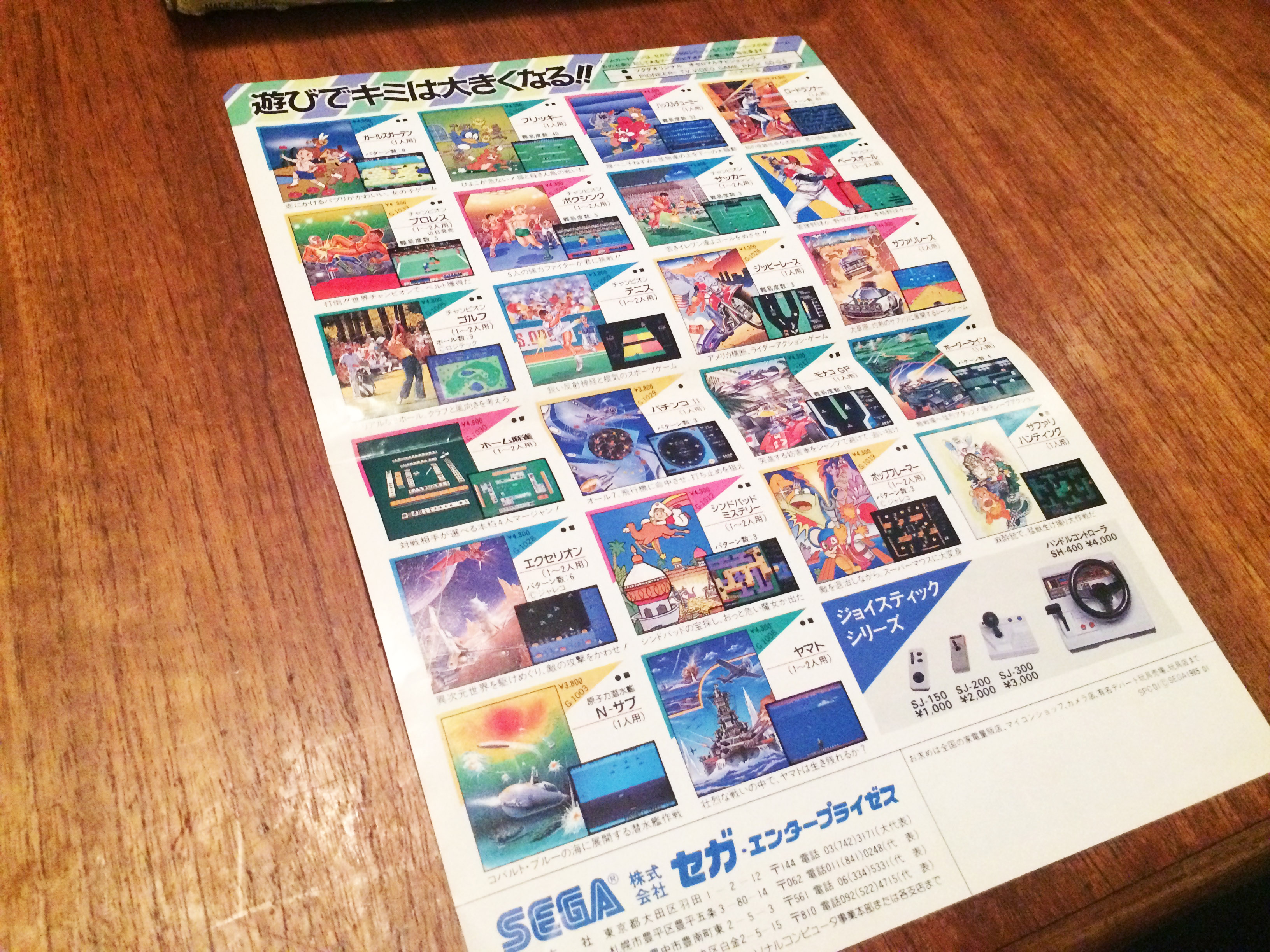
Dragon Scroll also came with these great advertisements for various Konami games and sountracks. Pretty cool when you have almost every item on a vintage ad!
This Japanese site (which I found because it flatteringly used this site as a source) has nicely collated most of the available cards, so this journey may go for many more years. Another great site Video Game Den also has good info on the available cards.
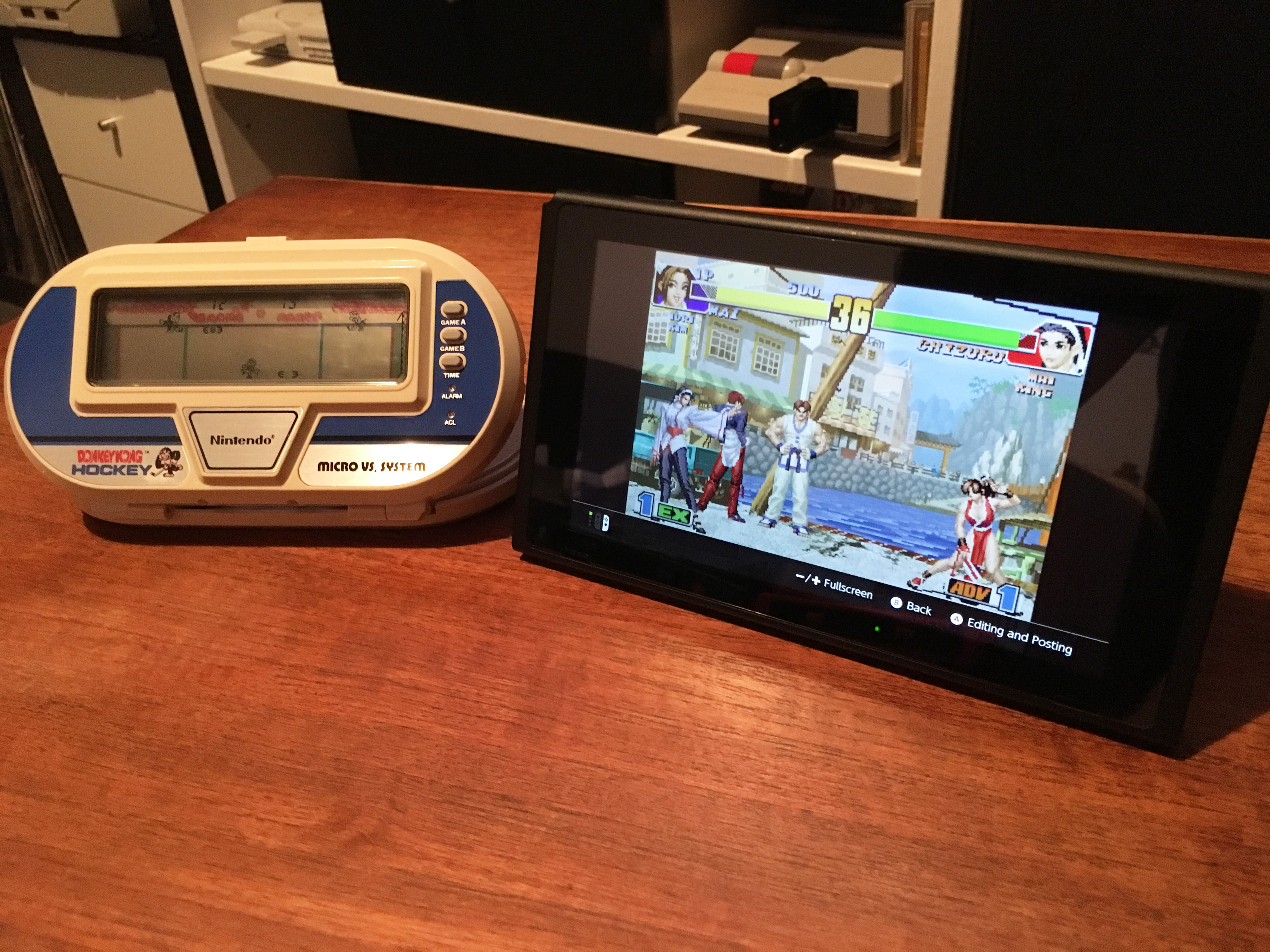
Nintendo’s Micro Vs. System series was the cutting edge way to enjoy multiplayer gaming on the go in 1984, combining the multiplayer fun of the Famicom with the portability of the Game & Watch line.
With (semi) detachable controllers for player 1 and 2, each unit only played one game, but quality engineering made the whole thing very cool.
Thirty three years later, the more things change, the more things stay the same. The idea has been reborn as one of the key features of the new Nintendo Switch.
If there’s anything Nintendo loves, it’s revisiting old ideas. Dual screens, stereoscopic 3D, and now on-the-go multiplayer have all made multiple appearances in the company’s history. The hybrid Switch has finally fulfilled the promise of the Micro Vs. idea.
Similarly, in the 80s, handheld Zelda was a massive compromise. Now there is no compromise.
In a sense, all of Nintendo’s gaming history has been pointing here. Exciting times.
With my recent acquisition of a Color TV-Game Racing 112, My collection now includes almost every major revision of every Nintendo home console ever released, complete in box.
Wii U
Wii
Gamecube
Nintendo 64
Virtual Boy (I’m counting it as a console, since it is really not portable)
A small confession: My Wii U is not a Japanese model.
There were a few more minor revisions of the consoles along the way – FF logo/non FF logo Famicom, output changes, different coloured consoles of various sorts (even shapes like the Pikachu N64), but these are all the major Japanese revisions. The Wii Mini revision was not released in Japan.
There’s one major item missing – the Computer TV-Game.I’ll almost certainly never get one of these. This ‘console’ is incredibly rare, insanely expensive, and its questionable if it was even a consumer product since it was literally an arcade game with TV out. It sold for ¥48,000 in 1980. For comparison the Color TV Game Racing 112 was selling for ¥5000 in 1980, and the Famicom launched in 1983 for ¥14,800.
The Sega set is on its way, but will take a few more years I think. So many revisions…
The SG1000 most likely did okay for itself all things considered, but in the wake of Nintendo’s superior (and much higher selling) Famicom offering, Sega pivoted to make their home console platform more Famicom-like.
While the eventual result was the upgraded Mark III console, the first fruits of this pivot were realised with the SG1000 II.
Essentially a repackaging of the original Sg1000, it is also a design link between the two generations of Sega consoles.
Like the Mark III (and Mega Drive) it features English text on the top of the console, explaining its purpose and function. This one is particularly cute and amusing.
Instead of the terrible SG1000 joystick, it now has Famicom-style controllers which attach at the back, and Famicom like controller docks on the side of the console (more on this in the controller rivalry article).
There were two revisions of the SG1000 II. One was a simple re-configuration of the original console, and the second featured major internal revisions – it consolidated several of the original chips (among them the ‘off-the-shelf’ Texas Instruments SN76489 sound chip and TMS9918 video chip) into one new custom Sega part. This later model is much closer to the circuit of the Mark III, and because of these changes can be modded to output an RGB signal.
Both console revisions look the same on the outside. Very late release SG1000 II consoles came with an updated controller, though it doesn’t seem this change lines up with the internal board revision changes.
The Sg1000 II is a somewhat redundant console from a collecting perspective. It lacks the ‘first Sega console’ cachet, but isn’t as useful as the upgraded, more compatible, more user-friendly Mark III.
And in terms of looks, the redesign is more modern but a bit plain. It lacks the nice simple ‘retro evolved’ vibe of the original, but doesn’t quite nail the ’80s futurism’ look that Sega perfected with the seriously stylish Mark III.
But I really like that Sega was developing their own unified design aesthetic, and so it does look pretty cool with this matching joystick.
Following my complete Konami Famicom Disk System set, I have finally completed the other half of the full set, every Konami cartridge exclusive Famicom game.
This set has taken over 20 years to complete. It was finally done when I managed to find a rare boxed copy of Exciting Boxing for a good price.
The first Famicom game I ever got was The Goonies, since it wasn’t released in the west and I loved The Goonies II. I originally played it on my NES via a converter, but it started my Famicom obsession.
Another early pickup was Parodius Da.
The rarest item is possibly Geki Kame Ninja Den (Legend of the Radical Ninja Turtles) – the Japanese version of the first Ninja Turtles game. Or maybe the third party published Konami arcade game Circus Charlie. Most valuable could be Geki Kame Ninja Den, Bucky O’Hare or Exciting Boxing.
I don’t have the DoReMikko–style big box for Exciting Boxing, or the late-era cartridge re-releases of the FDS games Akumajou Dracula, Bio Miracle Bokette Upa, or Moreo Twinbee, so there’s a small amount of room to grow the set. Unfortunately all four of those items are hilariously expensive.
Here’s the full set with the Famicom Disk Games added to the photo, including the large DoReMikko box up the back.
As for favourites, it’s pretty hard to go past the Contra games, Arumana no Kiseki, and Akumajou Densetsu.
Also Akumajou Dracula, Ai Senshai Nicol, King Kong 2, Gradius II, Salamander, Crisis Force, Maze of Gallious, Wai Wai World 1 and 2, Tiny Toon Adventures 1 and 2, Bucky O’Hare, Metal Gear, Bio Miracle Bokutte Upa, Exciting Soccer, Exciting Basket, Ganbare Goemon 1 and 2, Meikyuu Jiin Dababa, Falsion, Dragon Scroll… so many classics.
Konami were at their peak in this era, and I believe the single greatest developer in the world at that point. How the mighty have fallen.
Ninjas were everywhere in the 80s, and Japanese game developers were happy to fulfil the international demand for martial arts action. Nintendo’s console had Kung Fu, Ninja Gaiden, Ninja Turtles, The Legend of Kage, Shadow of the Ninja and many others. Sega had their Shinobi and Dragon Wang series, as well as their shortlived Ninja series.
Much like the Dragon Wang/Makai Retsudenseries, Sega’s Ninja series is a somewhat convoluted progression of the same basic game template over a couple of generations of hardware.
Ninja Princess/Sega Ninja – Arcade
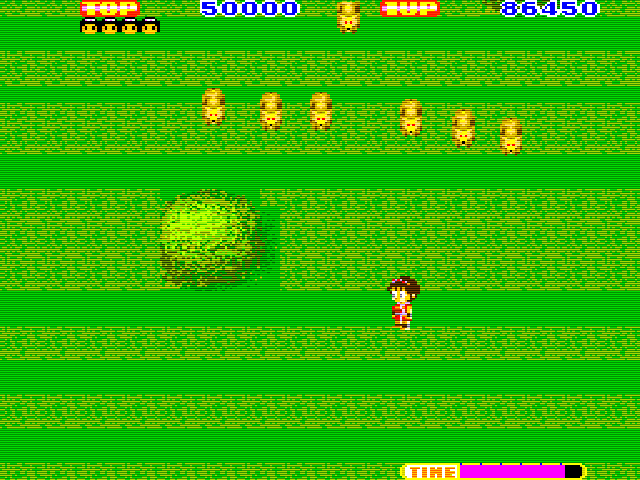
Ninja Princess (released in the west as Sega Ninja) began as a Sega System 1 arcade game in 1985. It’s an overhead run-and-gun game, one of a batch released around that time, such as Capcom’s Commando and SNK’s Ikari Warriors. Swapping out a warzone and slow moving bullets for Sengoku-era Japan and throwing knives, Ninja Princess is one of the first ever examples of an action game with a female protagonist, a whole year before the highly celebrated Metroid.
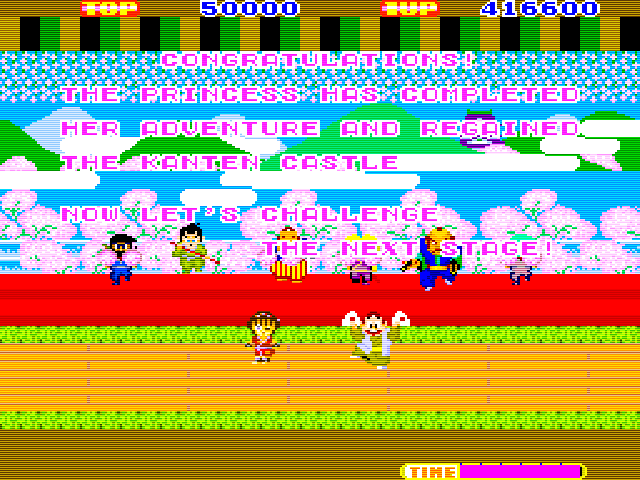
The game stars titular princess Kurumi, whose castle has been overrun by bad guys. She escapes a kidnap attempt in a cute animated intro, and sets out to take back the castle with her ninja skills.
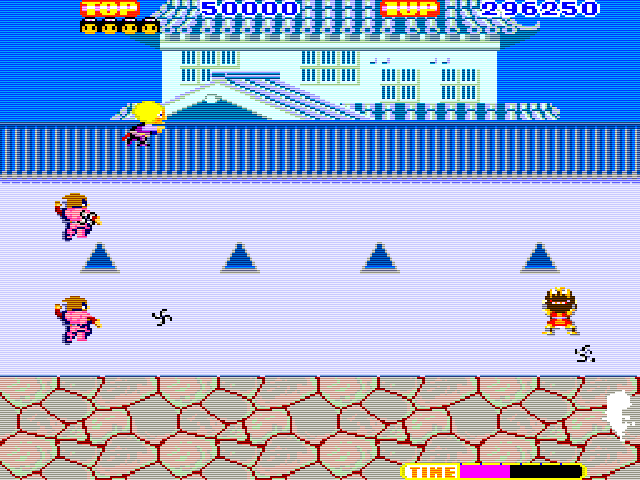
It’s a truly great example of the genre, with tight gameplay, great graphics and sounds, and some nice gimmicks. You have two fire buttons – one fires knives (or via a power-up, ninja stars) in the direction you are facing, and the other always fires directly up, no matter which way you are oriented. This innovation completely fixes the clunky feeling the genre can have, as you can actually fire at enemies while retreating. The third button activates a temporary ninja-vanish to evade enemy attacks.
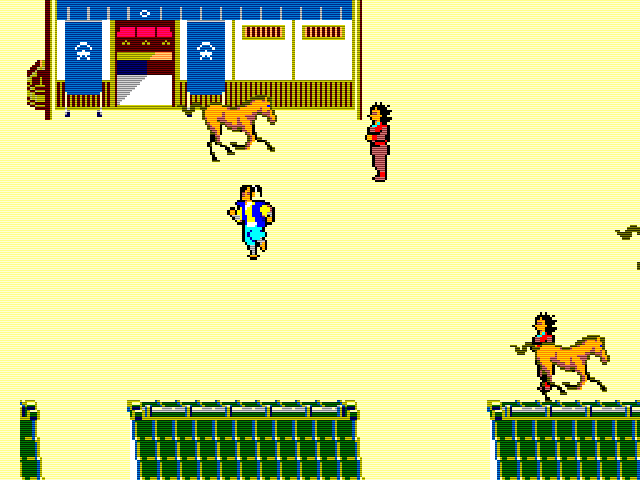
On top of this, Ninja Princess mixes up the gameplay with gimmick/event stages, including a stage where you avoid falling boulders, another with stampeding horses, one set on logs floating on a river, and two stages where you climb castle walls.
The graphics are fantastic, especially for 1985, colourful, detailed and stylish, and Kurumi herself is a particularly cute and nicely designed sprite.
The original arcade version is available on the Saturn, included in the compilation package Sega Ages Memorial Selection Volume 2.
It has a slightly squashed aspect ratio to fit in the Saturn’s resolution (but with no detail loss), and the graphics have been slightly retouched, mostly for the better. But it is a great way to play the game. One of the menu options allows you to play with infinite lives, which is a godsend, as being an 80s arcade game, it’s brutally difficult in the later stages.
Ninja Princess (忍者プリンセス) – SG1000
Sega’s first contemporary home port was for the SG1000 in 1986. As you’d expect, the graphics have taken a fairly big hit, and with only two buttons the ‘ninja vanish’ function has been mapped to hitting both action buttons at once, but it’s otherwise as faithful a port as could really be possible on the hardware.
The event stages are gone, but otherwise pretty much the entire game is intact, including the climbing stages. It’s actually quite fun to see some of the set-pieces from the arcade re-created in a more primitive form, and while the enemy ninjas are mostly single colour sprites in this version, their single colour often matches the primary colour of that enemy type in the arcade – you can see the designers of the port really tried to make it resemble the original.
The dinky SG1000 graphics have their own charm, and assuming you’re using a decent controller it plays really well for an SG1000 game. In an attempt to prolong the life of the title for home gamers, it introduces a ‘secret scroll’ system, and you have to collect all the secret scrolls to access the last level. They’re basically randomly located in the levels, so this is probably the most frustrating part.
While it had no chance of living up to the arcade original, it’s still very fun, and is one of the best games for the SG1000.
Ninja Princess 1 Mega Han (忍者プリンセス1メガ版) – Mark III
When Ninja Princess finally made it to hardware that could do it full justice – in the form of Sega’s newer Mark III console – it was ostensibly in the form of a sequel. Ninja Princess 1 Mega Han.
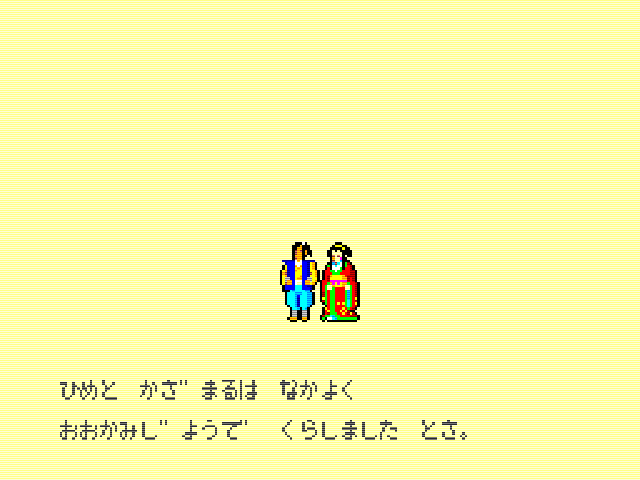
In what was assumedly an attempt to make the game more ‘serious’ (and perhaps appeal to console gaming’s primarily young male audience), the graphical style has been changed completely, removing any hint of the original game’s cutesyness. And instead of starring Kurumi the Ninja Princess, it stars a goofy looking dude named Kazamaru, who now must save the princess.
I wonder if Archie and Veronica will like my outfit?
Despite the long-winded title on the box, the title screen shows simply ‘The Ninja’.
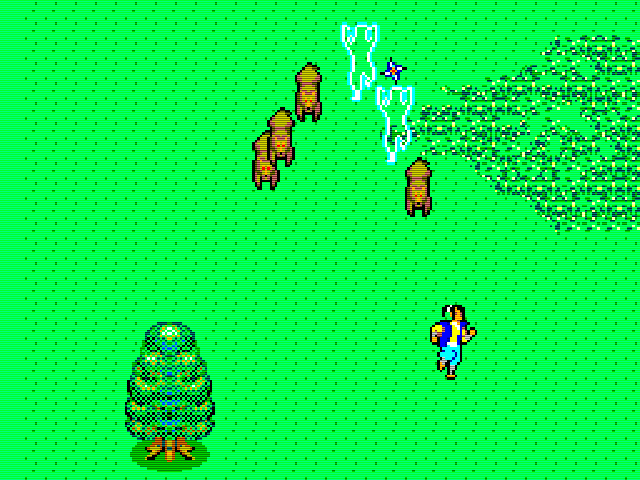
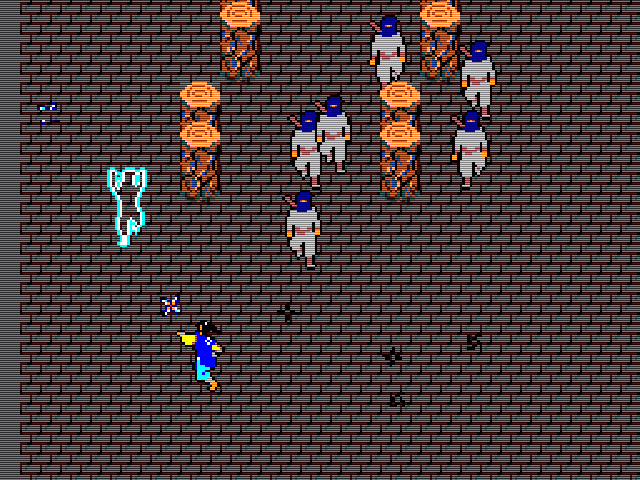
It’s set up as a sequel story-wise, but is actually another, more faithful, port of the arcade game. All the arcade event stages are back (in re-drawn form), including the falling boulders, stampeding horses, and river. Controls are identical and the scroll system is back from Ninja Princess SG1000, so you have to collect all five scrolls, then perform a particular task at a particular place to access the secret basement level and rescue the princess. There is also a new speed power up scroll.
It plays about as well as the arcade, but the new graphics are kind of badly drawn (especially the main sprites, including Kazamaru who looks as awkward in-game as he does on the cover), and the limited cartridge space meant there is much less detail and animation than the arcade game. Apart from the odd nicely drawn section, it’s not a particularly good looking Mark III game. There are more musical tracks, but they’re pretty bland, especially when your knives are powered up to ninja stars and you hear the same tune over and over.
The Ninja – Master System
Another Master System cover art ‘masterpiece’
Ninja Princess 1 Mega Han was released in the west under its title screen name The Ninja. While many Mark III/Master System games contain a universal ROM with both English and Japanese versions of the game onboard, The Ninja was actually ‘upgraded’ for its release outside of Japan. The western release gets a scrolling text intro, a new title screen, and an extra image on the splash screen when you collect all the scrolls.
Unfortunately the entire second level is missing, no doubt sacrificed to make space for the above. Which is a shame because it’s actually one of the better looking levels. Two of the secret scrolls have also changed location, one in particular makes a heck of a lot more sense in its Mark III location.
No village level for you, US/PAL Kazamaru!
And here the Ninja series ended. One fantastic arcade game, a very good SG1000 game, and a decent-but-nothing-special Mark III game. They’re worth a play through, but probably the best experience of the series is to be had on the Saturn port of the arcade game.














 Nintendo Sega Japan!

