What is the ultimate Super Famicom/SNES model? For me, it’s the Super Famicom Jr. (with RGB mod)
Like many consoles, the Super Fami got a late-life redesign. This slightly smaller model unites the design aesthetics of the Super Famicom and the US SNES model.
It takes the raised block surrounding the cartridge slot and ‘ruffled skirt’ foot trim from the American machine. Otherwise it follows the clean lines and rounded sides motif of Super Famicom, eschewing the ugly boxy purple/lavender-accented nightmare that was the American Super Nintendo.
This is similar to the direction Nintendo took with the AV Famicom, which blended Famicom and NES design elements (NES colouring and controller ports, Famicom shape and cart loading mechanism)
The Super Famicom Jr doesn’t support RGB out of the box, but it’s a quite simple mod to restore it. And once it’s been restored, it produces a stronger, higher contrast RGB signal than any other model.
It’s not actually that much smaller than a regular Super Famicom, but is very light compared to it.
It also comes with a slightly redesigned controller, with a nice molded Nintendo logo, and a longer controller cord.
Some people don’t like the blown-out contrast of this model, some prefer the softer RGB and slightly different hardware behaviour of the original model. And there’s an argument to be had that the original Super Famicom (and the PAL Super Nintendo which used the same design) is the nicest looking model.
But for me, the Super Famicom Jr is the nicest looking sixteen-bit Nintendo, with the best video output.
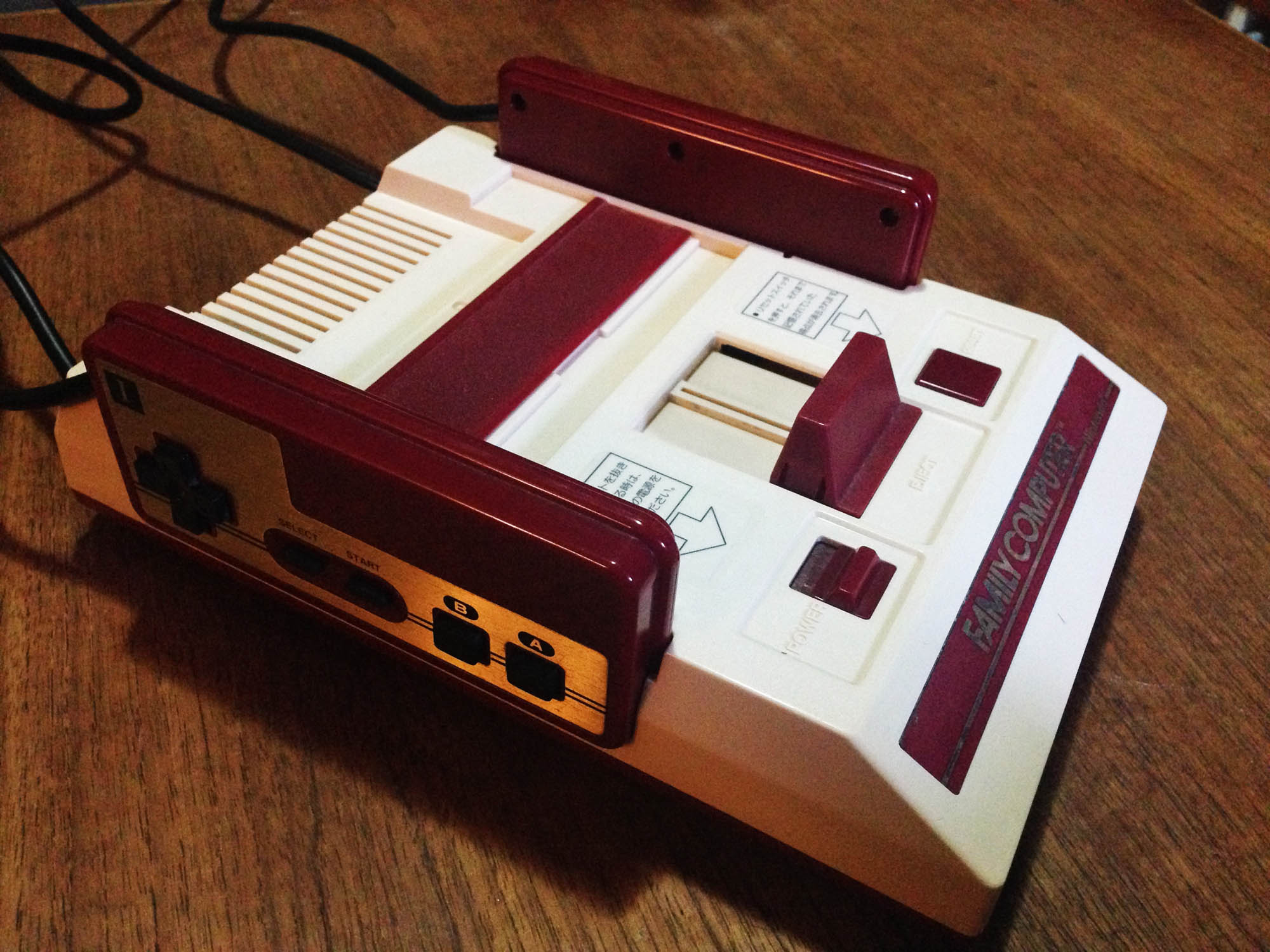
Two new consoles have been released by two prominent Japanese arcade developers – the Family Computer from Nintendo, and the SG1000 from Sega.
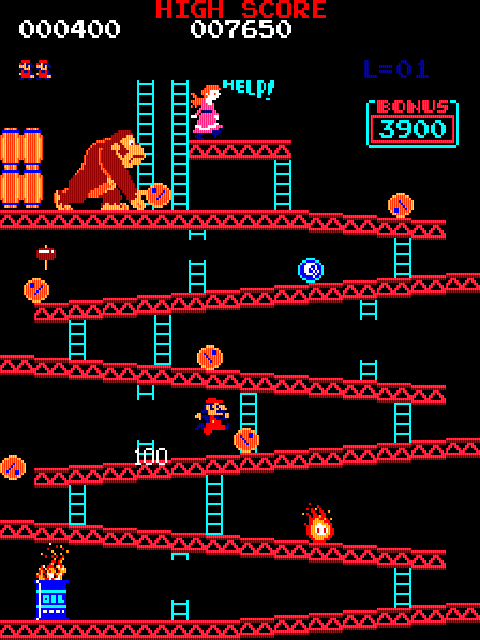
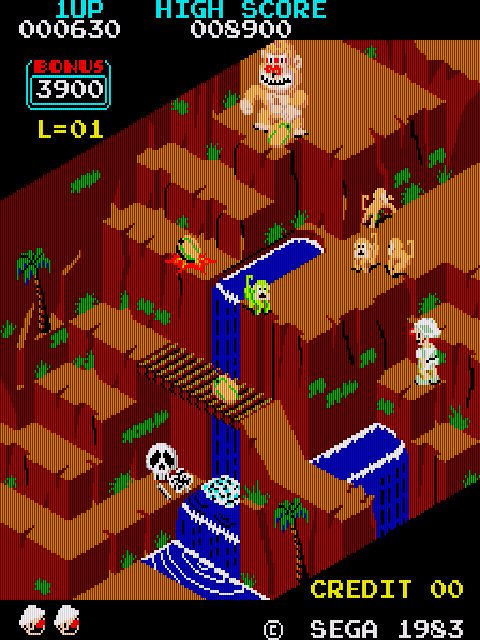
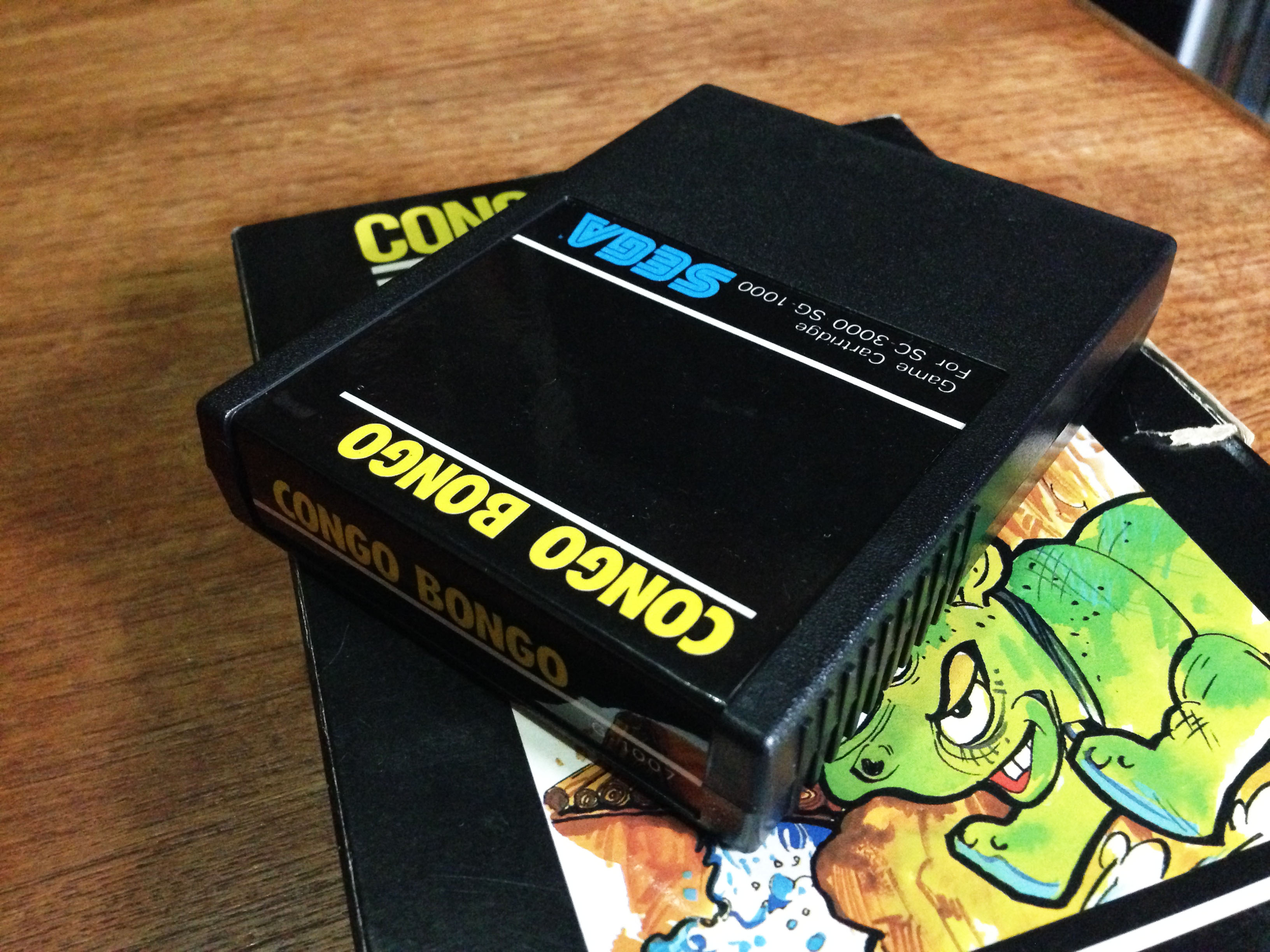
The big game in the arcades is still Nintendo’s Donkey Kong, featuring future superstar-to-be Mario. But the bigger name in arcades right now is Sega, whose Turbo and Buck Rogers: Planet of Zoom are doing incredible things graphically. And Sega now have themselves an answer to Donkey Kong – Congo Bongo. Essentially a conceptual clone of Donkey Kong (and in the later stages Konami’s Frogger), Congo Bongo differentiates itself with an innovative and incredibly impressive isometric 3D perspective.
In turn, both companies’ new consoles have launched with home ports of these killer titles.
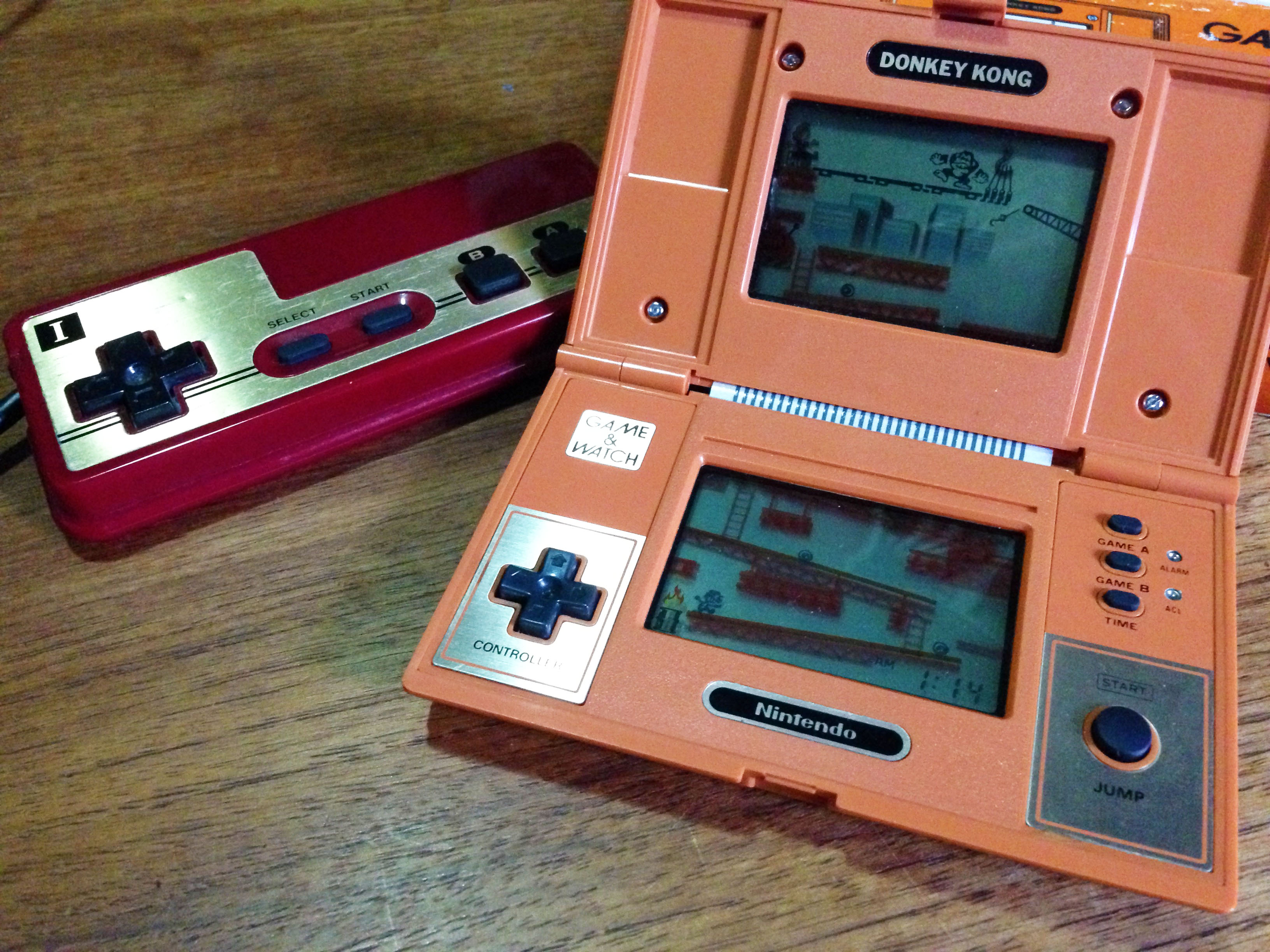
Of course, this isn’t the first time Donkey Kong has been made available at home. Aside from a variety of home console ports (including the solid Colecovision version), there is the fantastic Donkey Kong Game & Watch from Nintendo’s smash hit line of handhelds. The Family Computer itself has taken many design and packaging cues from the little handhelds, and this, along with Nintendo’s earlier Color TV Game series has given them valuable experience in the retail space.
So how do the two ports hold up compared to their arcade originals? Sega is taking the lead in the arcades, but are they up to the task of meeting Nintendo’s challenge in the home space?
Donkey Kong
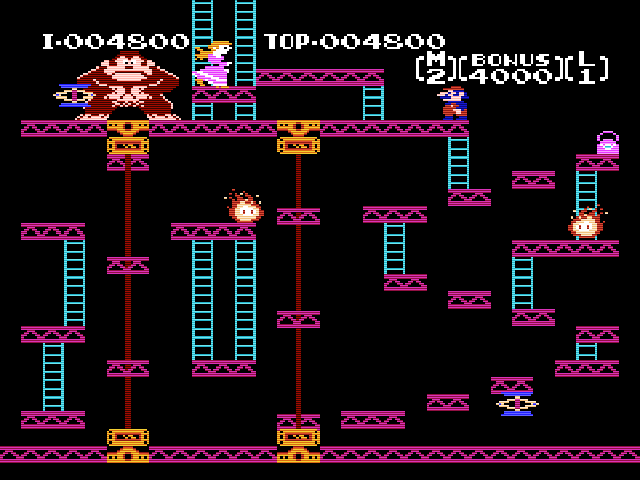
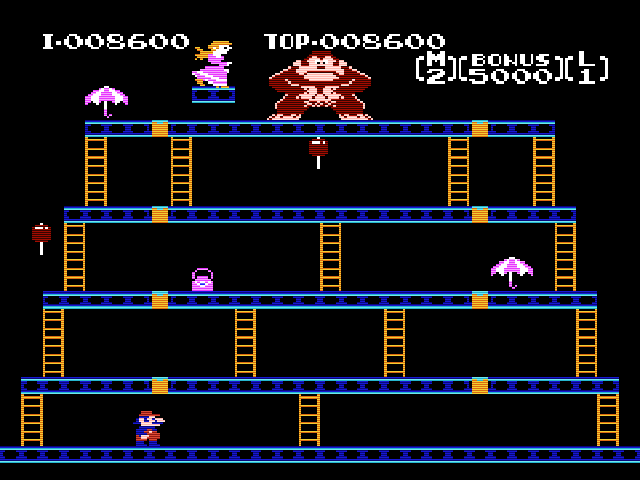
First up is the original. Firing up DK on the Famicom, the first thing that’s apparent is that the game has transitioned quite well from the arcade’s 3:4 aspect ratio to the regular television 4:3 aspect ratio.
It’s a little squished, but overall it works and is a very faithful port. Gameplay is replicated near perfectly, if anything it plays more smoothly, though it may have to do with the Famicom controller being more suitable for platformers than arcade joysticks.
The ‘secret’ safe spot to avoid the spring
The major omission is the third ‘cement factory’ stage, so DK on Fami has only three stages before looping.
There’s even the ending screen where Mario is reunited with Pauline (briefly).
The arcade intro and interludes are missing, and there are a few sound effect and animation omisions, but it looks and sounds great overall. It’s a clear step above the already excellent Colecovision version, and Donkey Kong on Famicom is likely the most advanced game available on any home platform to date.
Congo Bongo
Congo Bongo has a very interesting history, directly linked with Donkey Kong. It was developed for Sega by a software engineering company called Ikegami Tsushinki – the same team that did the programming work for Donkey Kong. While Donkey Kong was designed by Shigeru Miyamoto, Nintendo assumedly didn’t yet have the software development pipeline to make a top arcade game in 1981, and hired external software engineers. Sega grabbed the same team for their answer to Nintendo’s smash hit.
As soon as you hit start on Congo Bongo‘s title screen, the disappointment begins. Where is the isometric 3D? As a 2D game Congo Bongo is very much a poor man’s Donkey Kong.
What’s even more disappointing is that the Colecovision, a console with basically identical hardware to the SG1000, managed to have a port which maintained the isometric perspective.
The Colecovision version is very impressive
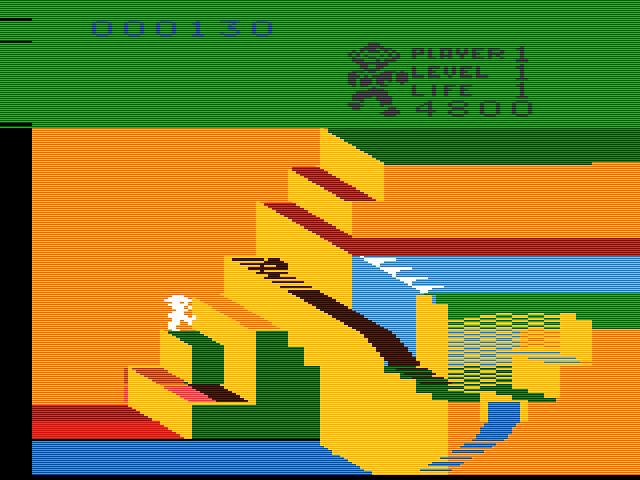
And unbelievably, a port to the ancient Atari VCS somehow did too!
This should not work but it somehow does…
But the poor SG1000 got a 2D version. There are only two stages, the Donkey Kong style stage plays from a side view, and the Frogger style stage from the top.
Despite all this, it still plays okay, if a little awkwardly, and in the grand scheme of things it’s not too far below the Famicom version of Donkey Kong. It’s not helped by the terrible SG1000 joystick, but even if you get around that by playing on an SG1000 II pad, controls are a bit loose.
I’ll take the one on the left please.
The SG1000 hardware could have done much better, and Sega proved it in 1985 when their isometric 3D shooter Zaxxon (which was also programmed by Ikegami Tsushinki and used the same arcade hardware) was ported to SG1000 with the 3D effect intact.
…
It’s little wonder the Family Computer took off. Donkey Kong was a premium product. Congo Bongo for SG1000 is decent enough fun and about as good as most games before that point, but is just an interesting artefact now.
Quite a few Famicom games, in particular Famicom Disk games, came in very fancy packaging. Many came in large boxes with extra stuff like figurines, cassette tapes, large format manuals, and in some cases even more outrageous things, like Exciting Boxing‘s giant inflatable controller. These are not like modern special editions, as in most cases these were the only release of the game.
For classy packaging, it’s pretty hard to go past Bothtec’s Relics: Ankoku Yōsai.
Inside the huge PC-game style outer slip is a metal case.
And inside the case, you have a large full colour manual, a sticker sheet, a disk-sized full colour monster manual, and the disk itself.
The disk case and monster manual fit inside foam slots, presented as valuable items.
The case allows removal of some of the foam, so if you want you can use the metal case to store 4-6 FDS games in style.
The monster manual gives every character in the game in a two page spread.
And the large manual is even nicer. Beautiful artwork is used throughout the presentation, and it does its job of making you excited to get into the game.
The game itself is almost as ambitious as the packaging. A Metroid-style sprawling action-adventure, it features huge sprites (for the time), large environments and a huge list of enemies and items. Set in a post-apocalytic world where dark forces have enslaved humanity, in the game you play as some kind of robot spirit guy who can possess the bodies of the dead. You must defeat all the enemies in a ‘sun fortress’ to free the good spirits (as well as the ubiquitous princess) to save humanity.
The graphics are pretty good for the time, and the music is catchy. Despite the immediately noticeably clunky controls, it is not hard to be impressed early on, as the world of Relics is intriguing.
Unfortunately the game doesn’t live up to its ambitions. Bothtec’s roots were in PC games (including some predecessors to this game) and it Relics plays very much like a home computer game of this type, it’s quite rough around the edges. Controls are not only clunky but glitchy, and it’s very very difficult to outmanoeuvre many enemies. It gets better as you power up later on, but getting to that point is a huge slog.
Worse than this are the load times. This game is always loading, I have not experienced any other FDS game like it. It does big loads every time you change screen, but there are small loads even within a loaded scrolling area when a new type of enemy appears. It’s really quite horrendous.
Despite these flaws, the adventure and exploring elements work quite decently in the traditional ‘try every direction in every order with every item’ classic 80s kind of way. Finding keys and power-ups in order to progress and remembering paths is always kind of fun when the world looks this mysterious, it’s just that it’s buried under layers of clunk.
It still feels like a somewhat genuine retro experience, playing a game like this with the large manuals and packaging in front of you. But I wouldn’t recommend it for anyone except 80s adventure fetishists.
Nintendo and Sega had a famous rivalry in the 80s and 90s. In this post I’ll focus on a single element – the first party controllers of their 8-bit consoles.
———-
1981
The story begins before either company has released a cartridge based console. In 1982 Nintendo completely reinvents cheap directional input with the calculator style ‘plastic button above rubber membrane’ design of the directional controller pad (d-pad) in the Donkey Kong Game & Watch.
It’s equal to expensive microswitch arcade joysticks in speed, reliability and precision. It has great tactile feedback thanks to the ‘give’ of the rubber.
1983 Donkey Kong II
It is a vastly superior solution to the standard Atari-style joysticks of the time, whose sticks and buttons use primitive leaf connectors (bending metal) to register button/direction presses.
———-
1983
Nintendo releases the first edition of the Famicom. The controllers feature the Game & Watch d-pad, and like Donkey Kong, soft rubber action action (A/B) buttons. Also like Game & Watches, it features soft rubber function buttons (Start and Select).
The rubber buttons are usable, and suitable for simpler games, but are not as responsive as the d-pad is, and on hard presses can get stuck on the corners. For this reason (combined with a rare graphics glitch issue) Nintendo recalls these models in early 1984 and replaces them for customers. As such they’re relatively rare in the wild.
Of note, the Famicom features controller docks on the side of the console, so cords come out the side of the controllers to facilitate this.
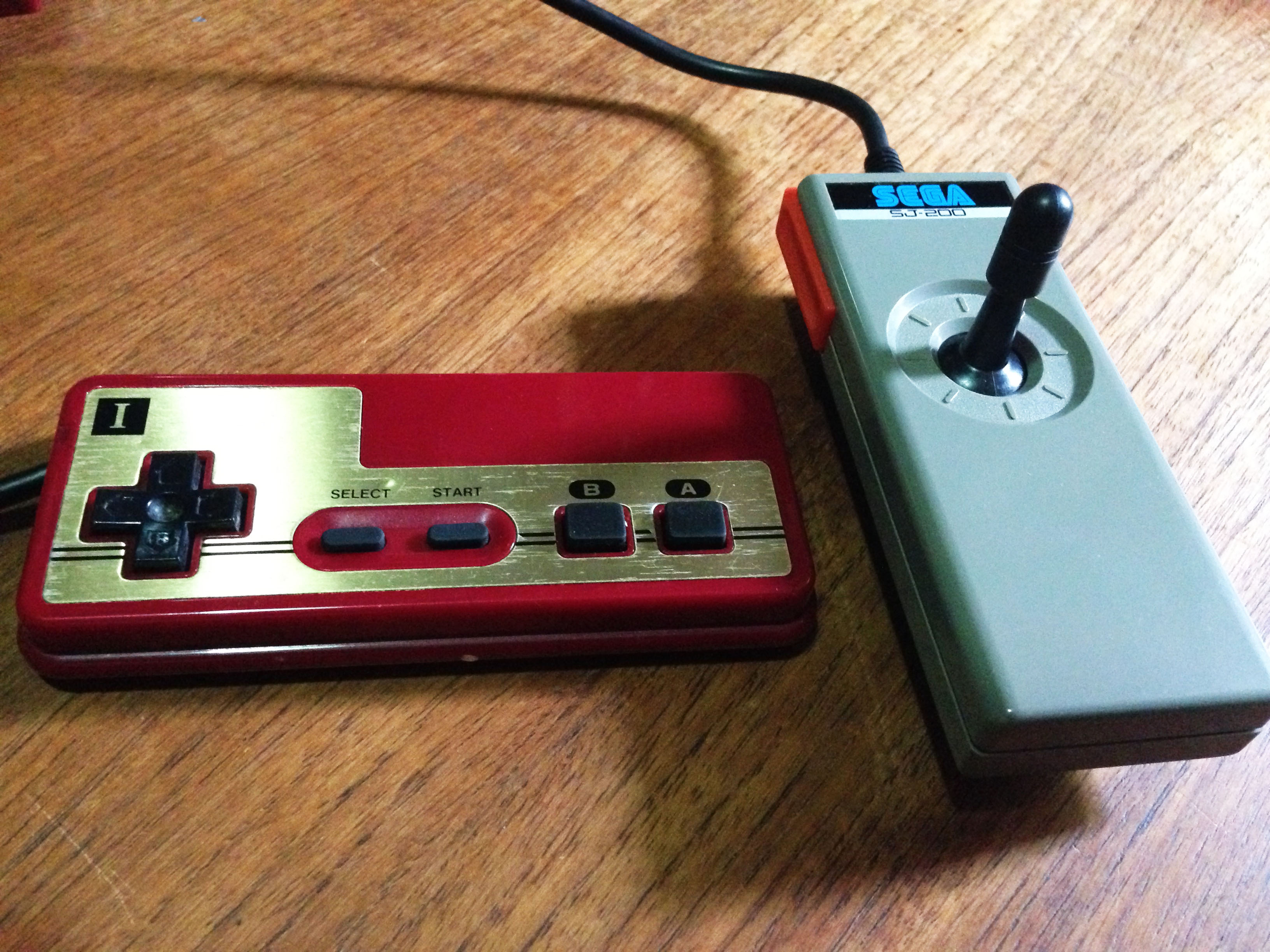
Still 1983, Sega releases the SG1000 console. The console itself is a generation behind the Famicom, and the SG1000 controller (SJ-200) is a primitive old-paradigm joystick that uses the unreliable old leaf connectors. It also only has two buttons to the Famicom’s four (the console itself features a ‘Hold’ (pause) button on the main unit).
It’s an absolutely terrible controller. The mini joystick is equally as bad as an Atari VCS joystick, but cannot be as easily wrenched around to ‘force’ it to work like an Atari one, due to the small size and the way you hold it.
———-
1984
Nintendo updates the Famicom controller to have hard plastic over rubber membrane A/B buttons for better responsiveness. They leave the less commonly used function buttons as soft rubber.
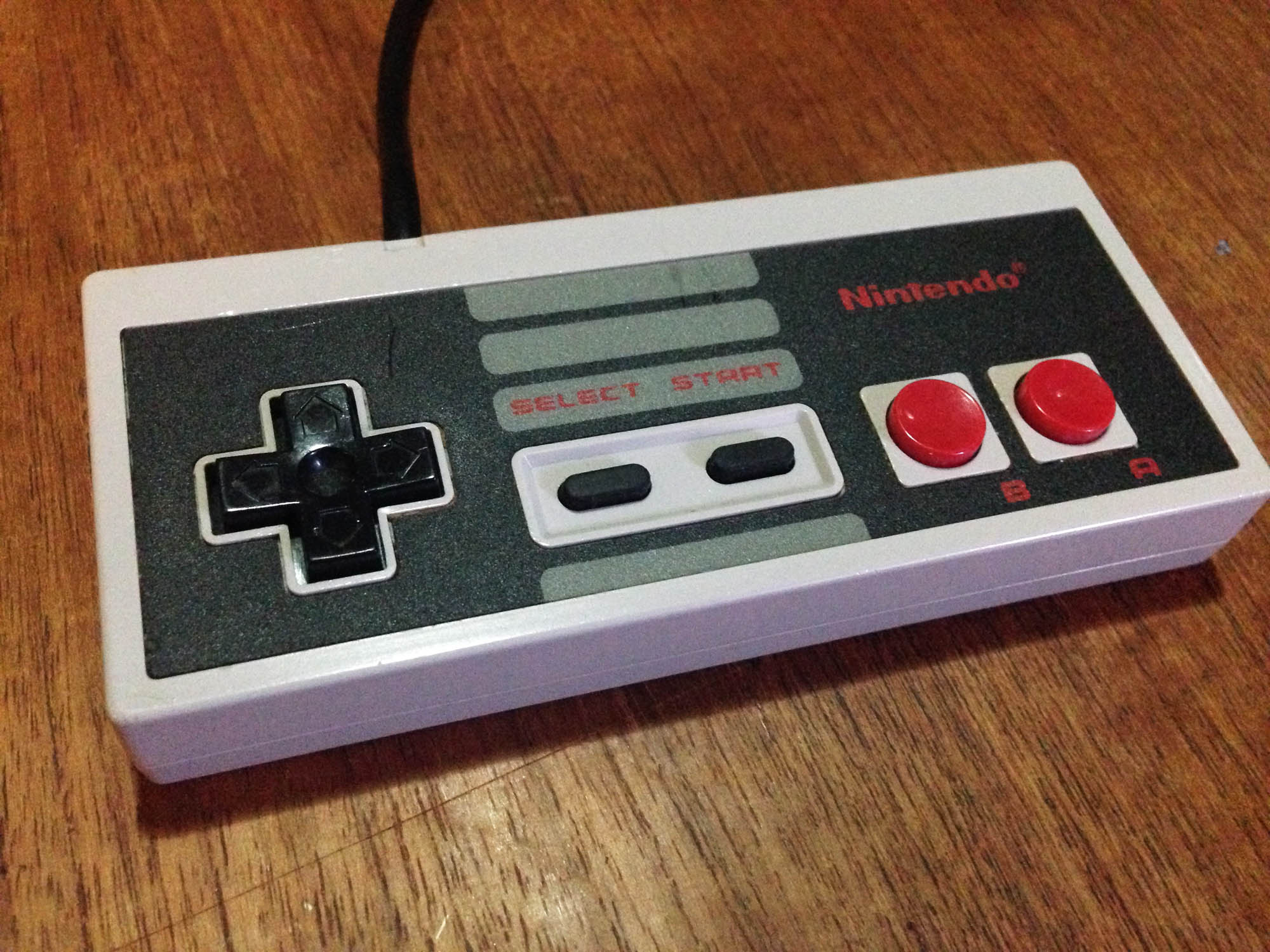
A brilliant controller that basically sets a permanent industry standard.
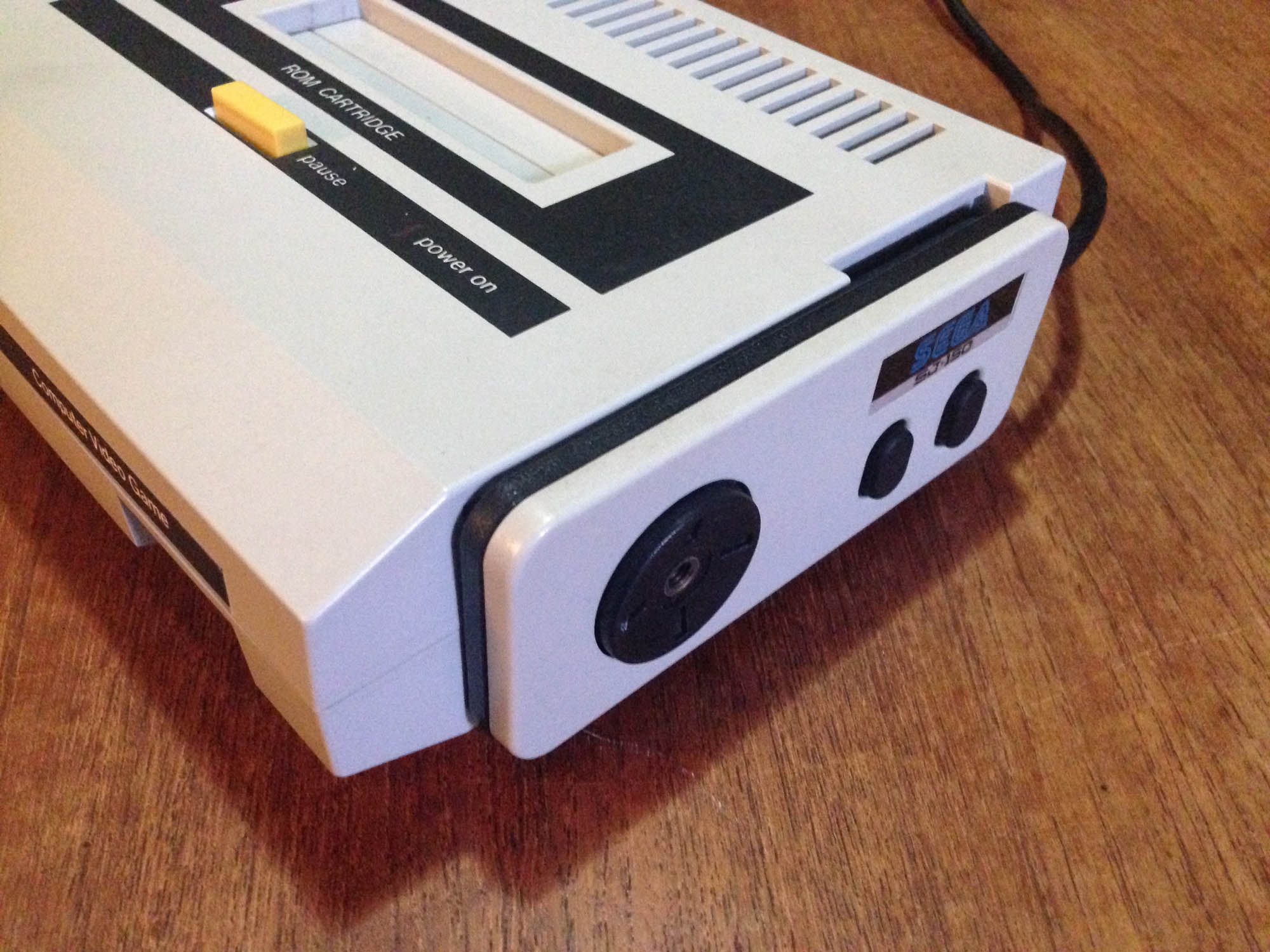
Later in the year, Sega releases the redesigned SG1000 II console, with the Famicom inspired SJ-150 controller.
The SJ-150 has a round variation of the Famicom d-pad, and a copy of the original Famicom soft rubber A/B buttons.
The new console ditches the unique look of the original SG1000, and takes more than a few design cues from the Famicom, including controller docks on the side of the console. Controllers are detachable from the console unlike the Famicom, but they plug in at the back, using an Atari-style DB-9 connector – a legacy of the original SG1000, which had a DB-9 plug for an optional second controller.
Interestingly, the SJ-150 tries to keep one foot in the old ‘joystick’ world, and comes with a little plastic stick which can be screwed into the middle of the d-pad, presumably for players who want some kind of joystick feel.
———-
1985
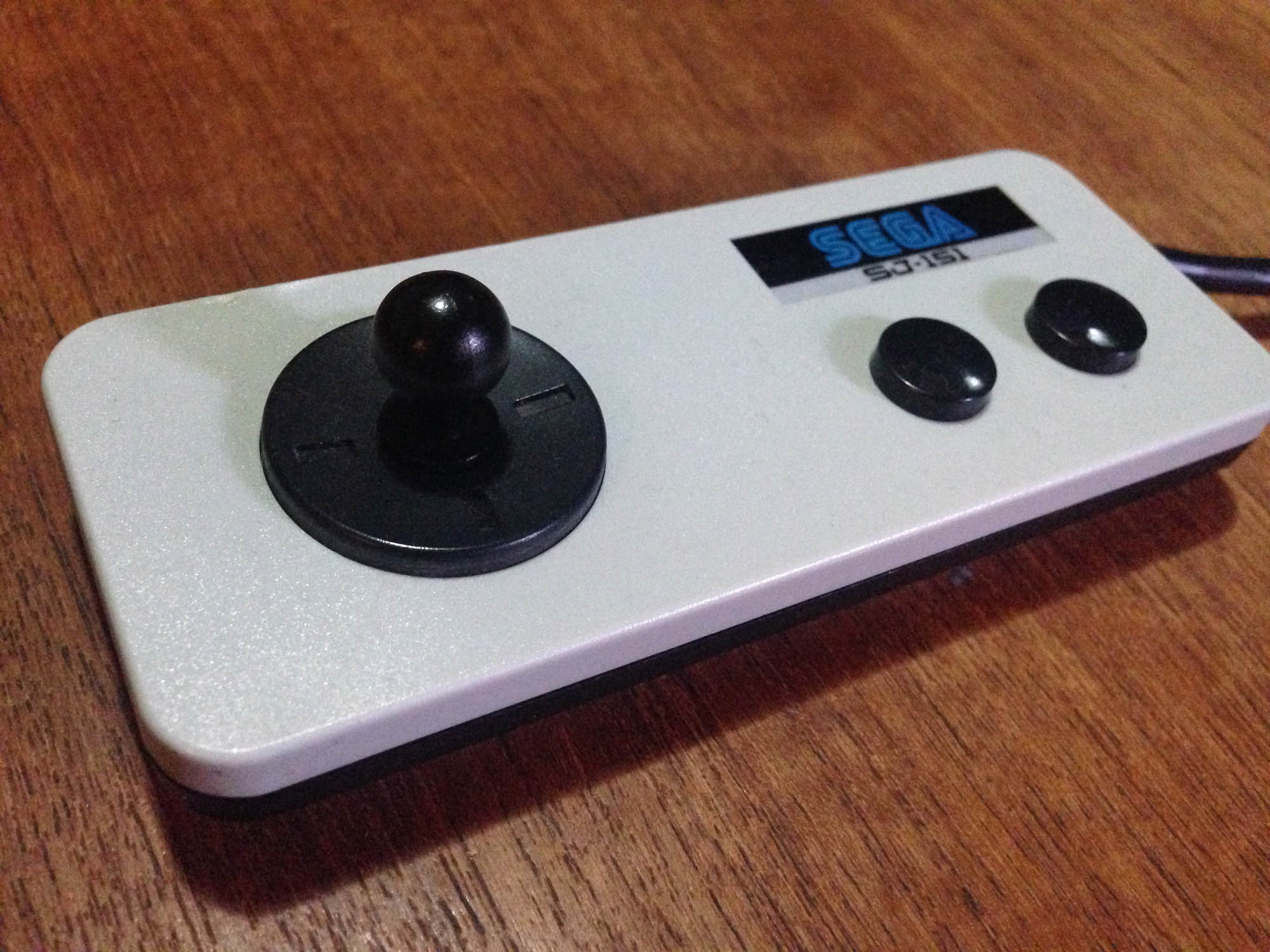
Sega releases the SJ-151 controller with later SG1000 II consoles, and it is moved up to the latest Famicom design, with hard plastic with rubber membrane A/B buttons.
This is the first all-round good Sega controller. It keeps the weird mini-joystick option.
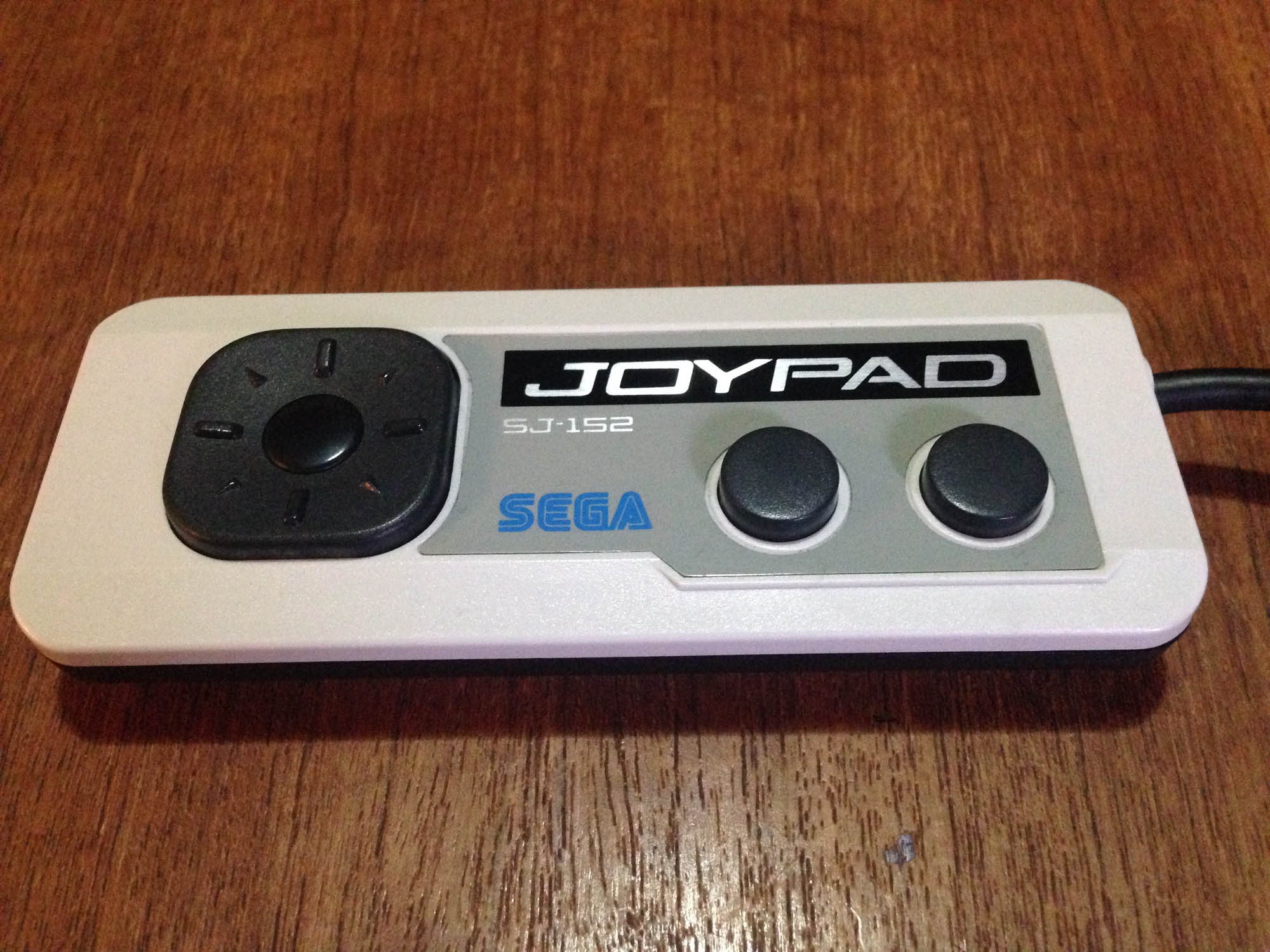
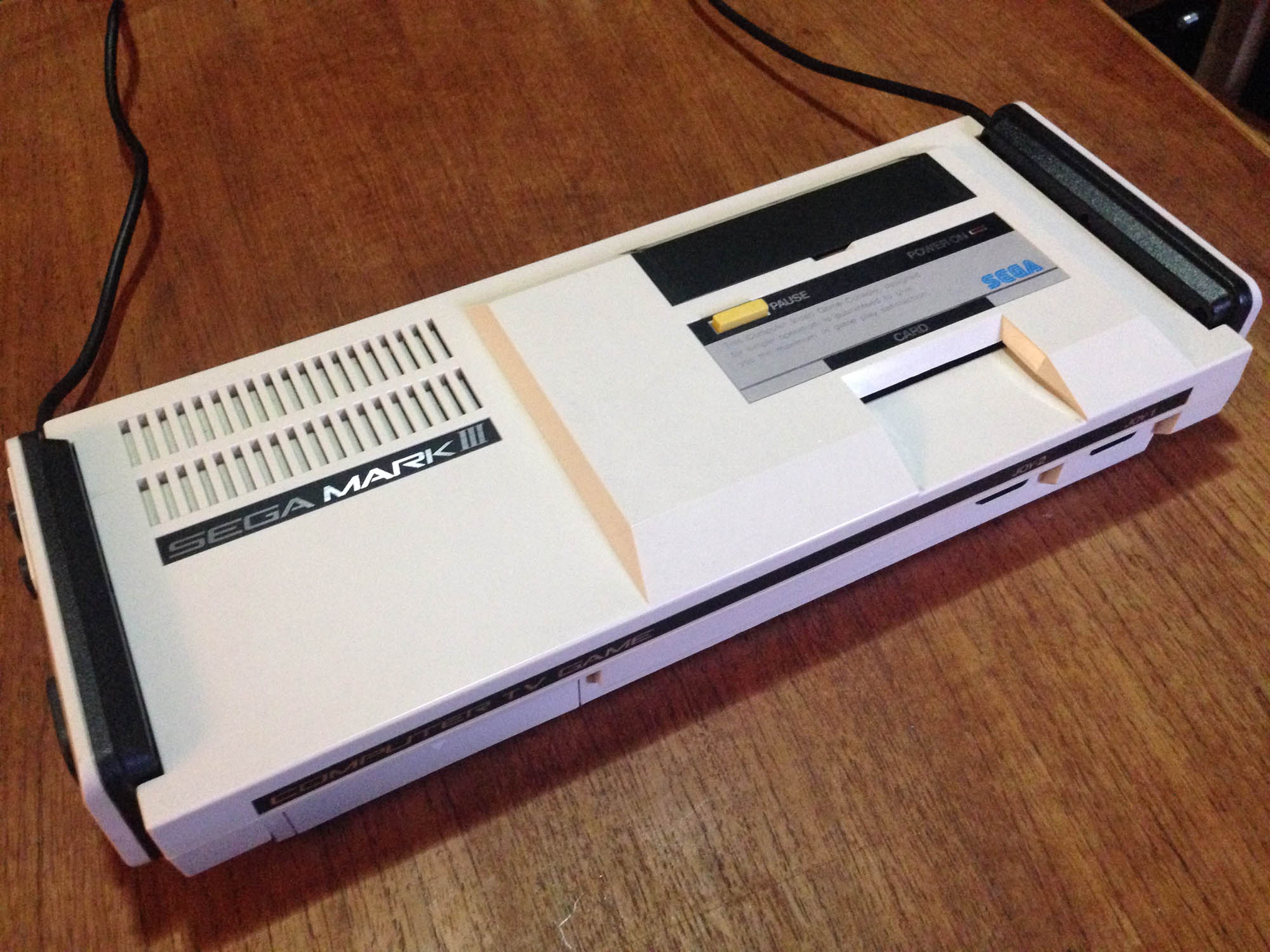
Later in 1985, Sega releases their upgrade to the SG1000 – the Mark III, with the SJ-152 controller, which is basically just a redesign of the SJ-151. It has more Famicom-like styling, with a reflective metallic sticker on the top mimicking the metal faceplate of the Famicom controller. Possibly due to the SG1000 legacy of the Mark III hardware, Sega is stuck with only two buttons for each controller.
The console continues to feature controller docks like the Famicom, though the controllers now plug into the front of the console.
It also retains the mini-joystick option. Someone must have liked it.
Later in 1985, Nintendo brings the Famicom west as the NES, with an externally redesigned (more squared off) controller that keeps all internals of the hard button Famicom pad as-is – it even uses the same board.
Due to the NES having no controller docks, Nintendo improves on the Famicom pad design slightly by having the cord come out the top instead of the side of the controller. It is however slightly less comfortable to hold due to the harder edges; the Famicom controller was nicely rounded.
———-
1986
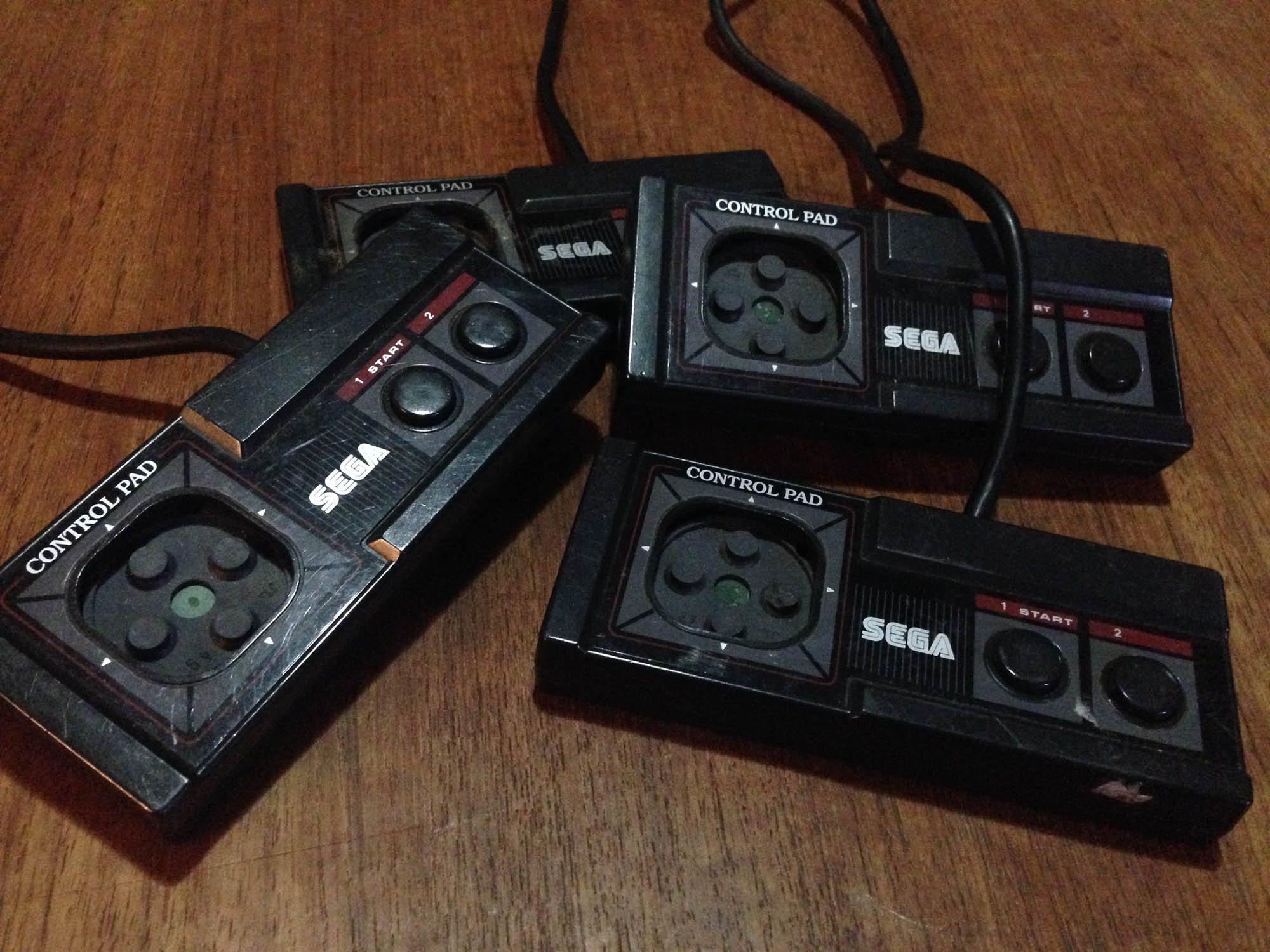
Sega brings the Mark III west as the Master System, with an externally redesigned (more squared off) controller that keeps all the internals of the Mark III pad as-is – it even uses the same board.
It has some weird raised sections making hitting the buttons and d-pad less comfortable, though the d-pad is still the half decent one from the SJ-152. It is also less comfortable to hold due to the harder edges. Unfortunately, despite the Master System having no controller docks to necessitate it, the cord still comes out the side. It still has the mini-joystick option.
———-
1989ish?
After the release of Sega’s next system the Mega Drive, Sega begins positioning the Master System as a budget system in some of their more successful territories (mostly Europe and Australia/New Zealand). They revise the Master System pad to have the cord come out the top like the NES, and finally drop the mini joystick attachment.
At some point along the way Sega farm out all Master System production to China, and the non-Japanese controllers (and consoles) were much lower quality, and broke incredibly easily. Especially the d-pad, which had a cost-cutting redesign, making it less responsive as well as more prone to breaking.
No first party controller breaks as easily as the ‘top cord’ Master System pad.
———-
1993
After the release of the Super Famicom/Super NES, Nintendo repositions their older Famicom console as a budget machine – in Japan as the ‘AV Famicom’ and as a Top loading NES model in the USA/Europe.
The new Famicom/NES comes with a new Game Boy/Super Famicom inspired controller, affectionately known as the ‘dogbone’.
It’s a great controller, a very high quality build, and easily the most comfortable controller of the generation. Some players prefer the ‘flat’ AB button orientation over the Game Boy/SNES-style angled orientation. I prefer the angle.
———-
And that’s where that battle ended. Poor Sega were 1-3 years behind at every single step.
Here’s the whole lot in one shot.
My favourite Nintendo controller is either the beautiful round button Famicom pad (or my hybrid Famicom/NES controller), or the dogbone.
My favourite Sega controller is probably the SJ-151. It has the better buttons, and the round d-pad works just a little better – the square one has a bit too much face surface. The SJ-152 is also quite decent, and it looks less plain.
There’s a Mark III 3DS theme out. Looks perfect on a white New 3DS.
Now we just need some Mark III faceplates. It’s still crazy to me to see the Sega and Nintendo brands together like this, even after all these years of it being normal (the dual branded F-Zero GX launch screen was the first real time they co-branded, back in 2003!)
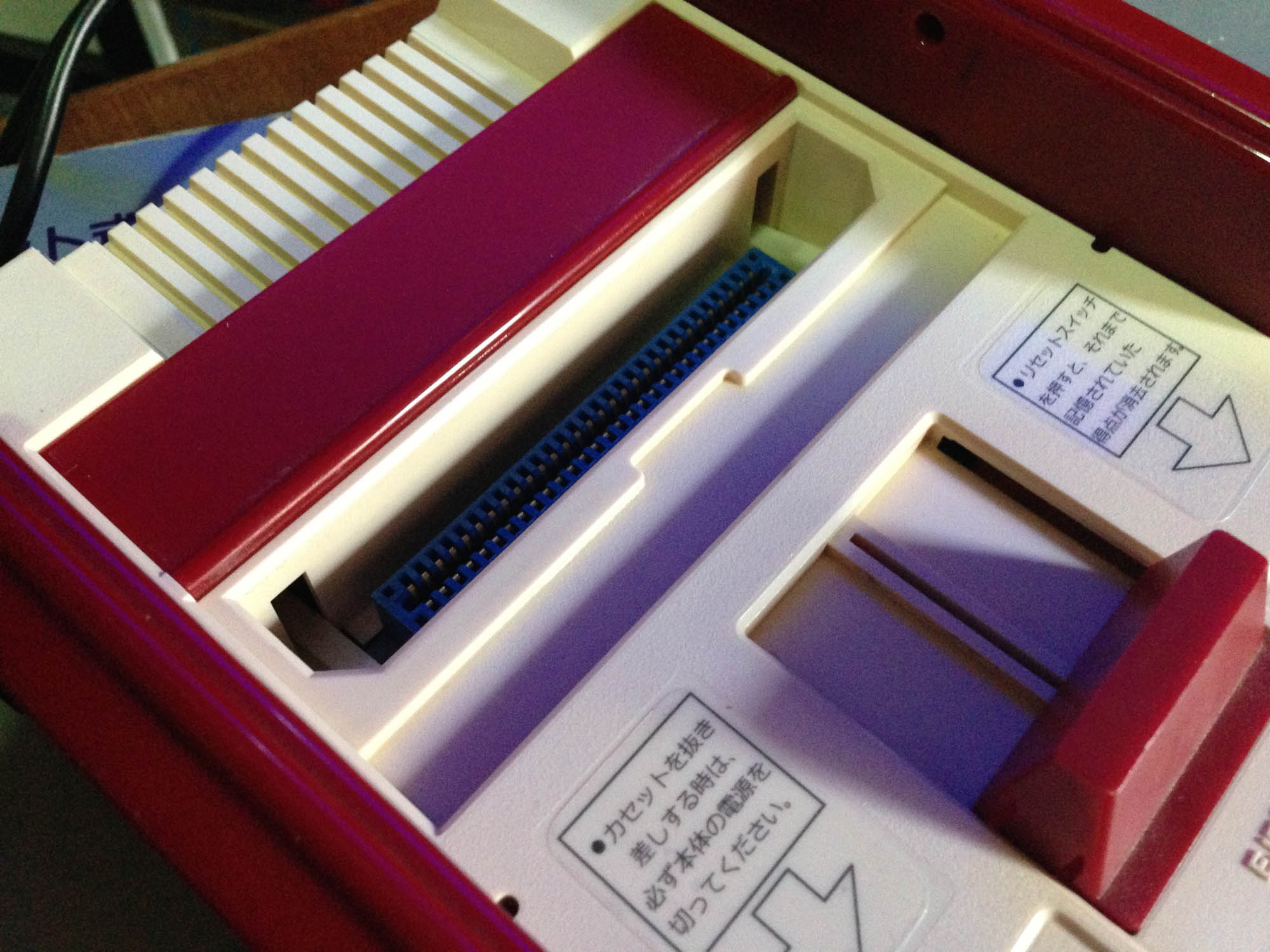
Paying attention to eBay auctions can get your some cool stuff. This Famicom was listed with just a picture of the box as the main image. One tiny detail stood out to me, so I bought it (for a quite low price).
It’s an original model of the Family Computer from either 1983 or possibly early 1984.
It features square ‘squishy’ rubber buttons for A and B on the controllers, much like the start and select buttons, and the action buttons on an early Game & Watch.
The other difference of note is a shiny finish on the bottom, compared to the textured finish of all later models.
I’ve done some restoration and cleaning including a peroxide treatment, and it turns out after the yellowing is removed, the console itself is a slightly different colour to other Famicoms, it’s got a slight red tinge. This solves the mystery of the reddish Famicom on the front of all Famicom boxes not matching the whiteness of later models – they changed the plastic around the time of the button change, but didn’t update the picture.
As far as I can tell, the early models didn’t feature an expansion port cover or arrow sticker on the front right – hence them not featuring on the box either. So these are not ‘missing’ here, they were never there.
Nintendo recalled all early consoles because of a bug that could cause it to crash, and because the square squishy buttons damaged easily and could get caught on the corners. After playing a few games with these controllers for a few minutes, they’re quite solid, but definitely inferior as buttons the the hard round ones with membrane switch that replaced them (Nintendo also phased out this button style in later Game & Watch releases. They have a long travel distance, and while they work fine for holding or pressing sporadically, if you have a game that requires hitting a button in quick succession (e.g. a beat em up), it feels ‘slow’ as you have to do a more substantial press each time.
The manual has square buttons featured as well, so this set is all-original.
Here are the three generations of original Famiom. Square button, round button, and round button with Famicom Family ‘FF’ logo. Note the slightly different colors of plastic, my second gen Famicom is the only one I would actually call ‘white’, it makes the ‘normal’ beige colour one on the right look yellow.
Intesrtingly the console box was never updated to feature the ‘FF’ logo.
Sometimes it’s difficult being a fan of Japanese games when living outside of Japan. If you’re in a PAL country, older RF-only NTSC-J consoles cannot ever display properly on PAL screens. You could possibly tune in a fuzzy black and white picture with no sound, at best. Even if your TV was NTSC compatible via other inputs (eg composite), it is unlikely to support NTSC over RF.
You can mod most RF-only systems to output composite video or better, but personally I prefer not to mod rarer or older consoles such as the SG-1000, Color TV Game 6, or some of my original Famicoms.
No modding for you!
The traditional method was to use an NTSC-J compatible VCR which takes in the RF signal and outputs in PAL composite, but they’re getting harder to come by, are cumbersome, and you also end up with additional artifacting from the composite signal itself.
So here is a cheap solution, a $20 NTSC RF to VGA box – essentially designed as an external analogue NTSC TV capture card. It takes in RF (or composite via side inputs) and outputs in VGA plus 3.5mm stereo jack for audio, with various scaling options.
It can tune in these older consoles, and output via VGA, and the results are much better than I expected. The scaling, for what it can do with a fuzzy RF image, is quite solid. Options are selectable via an on-screen menu, and it even comes with a remote control.
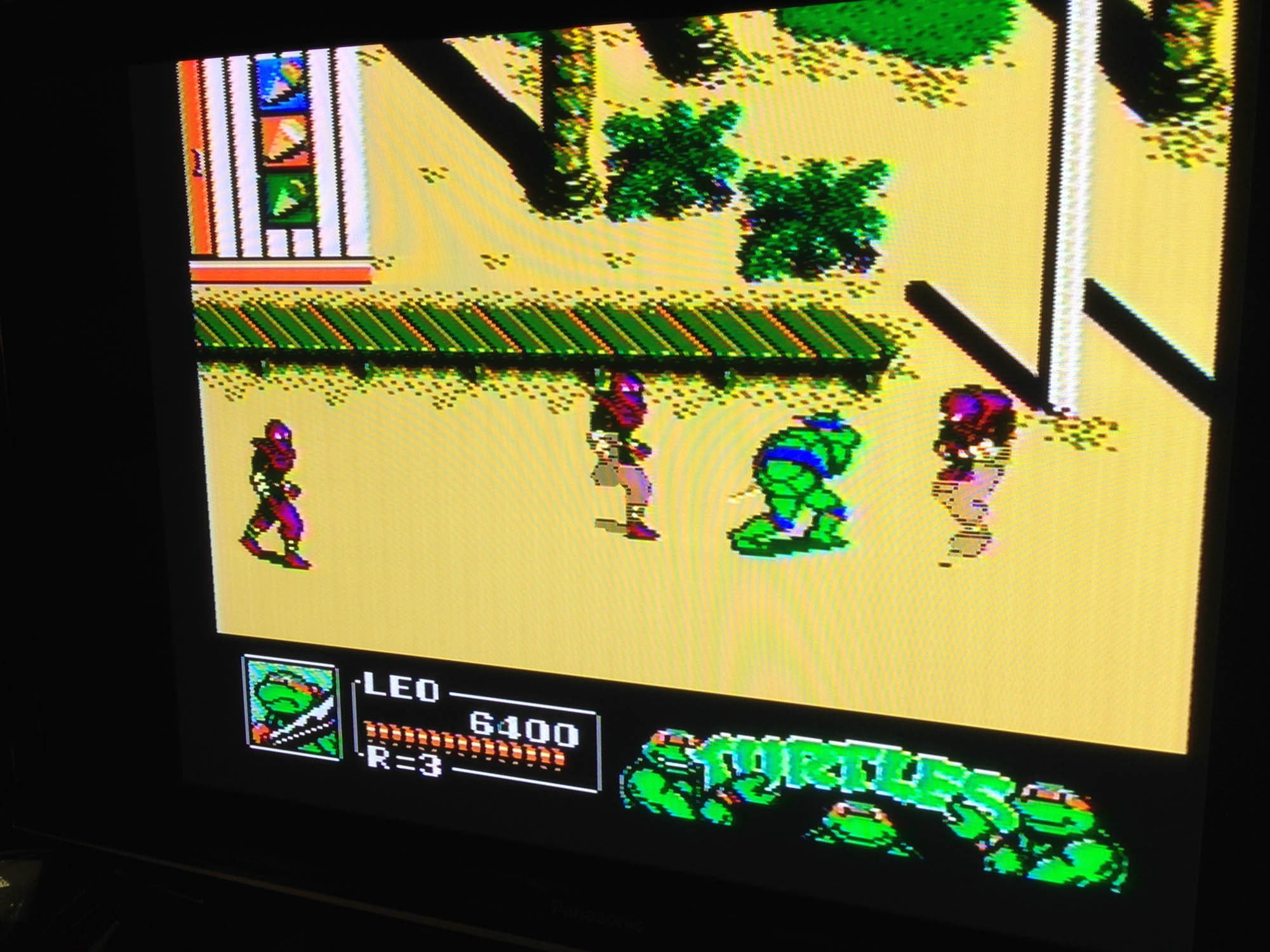
And here are the results, Turtles 2 on on original Famicom to a 1080p Panasonic plasma.
The distortion lines are just from photographing the TV, it’s actually quite clean.
I’ve made a video of it running here:
The downside is that the tuner is NTSC-U, so still not 100% compatible with all Japanese consoles. I couldn’t get the SG-1000 working perfectly, the colours were off. However the Color TV Game 6 worked great, as did two different Famicoms, and a Super Famicom via RF.
It seems to have particular trouble getting sync with primarily plain background games. It eventually clicks and then stays in sync, but this can take a couple of minutes. However, in all these cases, sound is pretty much perfect the whole time.
Overall, it’s a pretty cheap solution to at least test RF consoles, and good enough to play many!
Update: I’ve since gotten a new TV which has no VGA input, but which has an international analogue tuner, so I no longer need or can use this box, but will hang onto it for possible future usages.
Do you think Nintendo started in home video gaming with the Famicom? The Game & Watch?
It actually all started in 1977 with this, the Color-TV Game 6.
Pre-dating the Famicom by six years, The Color-TV Game 6 was a Pong clone, offering six variations on the basic light tennis formula. Above is the first edition, CTG-6S, which came in a creamy white colour. Subsequent releases were orange, below right is the most common variant, the CTV-6V.
You can play a classic Pong type game, plus variations with half sized paddles, and a mode with four paddles.
It runs off six C batteries, and connects via RF as per all consoles of the era.
The orange re-releases also added the ability to use an external power adapter.
The orange ones also had improved dials. They rotate more smoothly, have less ‘give’ before they star registering, and stop rotating when your paddle is off the screen. CTG-6S dials just keep rotating, and your paddle comes back from the top of the screen after moving off the bottom, and vice versa.
The manuals of these two variants.
It’s pretty primitive but works perfectly 38 years later. The simple circuitry is pretty sturdy and will likely outlast most consoles easily.
It was followed up by the Color TV-Game 15 which featured more pong versions, Color TV-Game Racing which played a car game, Color TV-Game Block Breaker which was a Breakout clone, the Computer TV-Game which played Othello, and finally the Family Computer.
Similar to Smash Ping Pong, Circus Charlie is a Konami arcade game that was released on the Famicom, but published by another company. In this case the publisher is the mysterious Soft Pro International, who dropped a few 8-bit games in the 80s then disappeared.
In the game you play as Charlie the clown, and must perform various stunts for the crowd over five levels. The first level has Charlie riding a lion and jumping through rings of fire.
There’s also tightrope walking, trapeze, balancing balls, and a strange level where you jump onto trampolines from the back of a pony.
It’s very much in the early 80s arcade mould of simple, short levels which repeat after a loop, and the goal after seeing each level is simply to get the high score (think Donkey Kong).
It’s a relatively faithful adaptation of the arcade game. Five out of six levels are intact, and they play almost identically, despite the move from vertical to horizontal orientation.
But while sound effects and music are pretty much on par, the graphics have taken a pretty big hit. Gone are the bright, colourful tones of the arcade, replaced with a sad, drab circus right out of the Communist Bloc.
Comrade Charlie?
Matching the early Famicom arcade heritage gameplay and presentation, Circus Charlie comes in the original small size Famicom box, much like the first Nintendo games, and the original Konami orange package line.
Circus Charlie was later released in original arcade form in the compilation packages Konami 80’s Arcade Gallery on the original Playstation and Konami Arcade Collection on Nintendo DS. The Playstation version is pretty much the go-to if you want to experience Circus Charlie properly. The DS version is a nice novelty but to view the game in correct vertical resolution you need to hold the DS sideways which is pretty awkward.
As for the Famicom release? It’s still pretty fun, in that pre-Super Mario Bros arcade gameplay kind of way. It is however extremely rare. I bought the only boxed copy I have ever seen.